Writer’s Block: Wednesday Workshop

IMG_0182

Writer’s Block

Every day, well, almost every day, I meet people who tell me that they cannot write anymore. They have abandoned their current project. They sit in their work space and stare at blank screens or empty walls. They have come face to face with the dreaded Writer’s Block.

While some consider Writer’s Block to be an actual illness, others flaunt it like a flag or a badge of honor:

“Don’t touch me — I’ve got Writer’s Block: I wouldn’t want you to catch it.”

“I’m having a bad week: I’ve got Writer’s Block.”

“Sorry, I can’t make the writer’s meeting, I’ve got Writer’s Block.”

According to Wikipedia, “Writer’s block is a condition, primarily associated with writing, in which an author loses the ability to produce new work or experiences a creative slowdown. The condition ranges in difficulty from coming up with original ideas to being unable to produce a work for years. Throughout history, writer’s block has been a documented problem.”

We have probably all experienced the sensation of being unable to write, unable to think, unable to continue. As an academic, I found that something similar happens frequently in examinations with young students whose minds suddenly go blank when faced by a white page and an awkward question. This form of Writer’s Block comes at the most unfortunate times. Students need to be switched on just when their minds switch off. And something similar happens to writers.

Examination Block can be overcome. In many cases careful preparation for an exam will reduce or eliminate examination block. These preparations may well include correct note-taking and relevant revision procedures. There should be no last minute all-night study the night before the exam and a good night’s sleep, proper food, and water are essentials. Appropriate physical exercises before the exam starts are also useful as these make the heart beat and the blood flow. All these things prepare both body and mind and free the student for that most important task: the struggle with the blank page and the awkward question.

Will a similar set of preparations work for those who suffer from Writer’s Block?

In order to answer this question, I would rather take a different approach. Instead of seeing Writer’s Block as a physical / mental presence that stops us writing, why not look at it as an absence that can be overcome? What can we call that absence? Personally, I look upon it as an absence of creativity. If the creativity isn’t there, then writing creatively won’t happen. So what do we do?

Let us define creativity. For me, creativity is the expression of the creative principle that dwells within all of us. It is there, within us. We may suppress it or we may let it be suppressed. We may ignore it or we may deny it: but it is still there. It is always there. Sometimes it is beaten out of us; or we think it is. But it is still there, beneath the surface, waiting to be called on. The Roman poets spoke of it as Deus est in nobis … the god that dwells within us.

Creativity, for me, is like a river that vanishes underground and then reappears: it will be back.

The most important thing in my opinion is what you do when you’re not writing, what you do when you’re faced with that wall of blackness, what you do when you stare at that blank screen and nothing makes your fingers dance on the key board.

Here’s what I do. I make up my mind not to force myself to be creative. Forget about writing. Do something else. Ignore all idea of Writer’s Block, or the End of the World, or the Imminent Disaster of not being able to write. It may take a mental effort, but forget about it.

Now do something else, something positive. Different people respond to different stimuli. Here’s what I do.

(1) I read books
I read other people in their creative moments. I love reading people who write in other languages that I speak and read, because my own mind tries to recreate their images, their stories. This re-creation is a form of creation in itself. New words, new ideas, new combinations, rise to the surface of the mind, like bubbles on a river.

(2) I color and draw
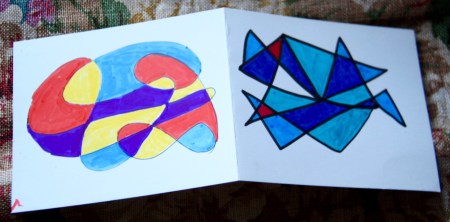
As any who have seen my drawings know, I cannot draw. However, I can take a line for a walk. And that’s what I do. Then I color the spaces I create. My friends thought I was wasting my time and I believed them until I read one of Matisse’s sayings: “My ambition: to liberate color, to make it serve both as form and content.” Voilà: I have my raison d’être. Nature abhors a vacuum. When you create a space, color and meaning rush in.

(3) I take photos
The capturing of a moment: a sunset, a new bird at the feeder, deer wandering through the garden, a black bear visiting, rain on a spider web, sunlight through a prism, a cat made out of cherry stones … the re-creation of the moment is the creation of the memory. More bubbles flow on the surface of the stream.

(4) I go for a walk, look at nature and the world around me, people too
It is incredibly important to do this. A visit to the local coffee shop, a walk around the super-market or corner store, a seat in the park on a sunny day … just be yourself, believe in your existence, watch things as they happen, relax, look and listen, empty yourself, let the world flow back in … look at the ducks on the lake or the goldfish in the tank … more bubbles on the water, more ideas floating down the stream …

(5) I listen to music
De gustibus non disputandum … we can’t argue about taste. Where music goes, each person must make their own choices. The music I like fills my mind, relaxes me, flows out when it ends, takes my mind for a walk and leaves … a vacuum … into which dreams and colors, words and ideas, build like clouds …

(6) I cook
Cooking has always relaxed me. Sometimes the repeating of an old recipe helps clear my mind. Sometimes I have a need to invent something new. Hands and mind occupied, the secret, sacred underground river of creativity flows on …

(7) I sew
Last summer, an unexpected event led me to join a quilting group … oh what fun … a man quilting among a dozen women … I learned so many things … so many different ways of looking at the world … so many concepts that I would never have dreamed of on my own … Sewing runs in the family: I still have my grandfather’s sewing kit … darning and sewing needles that served him for two years before the mast … that darned his socks as he survived in the trenches of the First World War … it bears his name and I use it with pride … and what memories arise in my mind as I choose the needle … his needle … the one that will lead me into the next adventure, be it quilt, button or patch …

(8) I keep a journal
… and come hell or high water, I write in it every day and have done so since 1985. That’s 31 years during which I have scarcely missed a day. The writing maybe banal, it may be nothing but a note on the weather or a comment on a sporting event … but it’s there … a vital challenge to the idea that Writer’s Block can take me over and stop me writing. This journal is 95% drivel … maybe more … but bobbing along the stream of words are ideas, verses, rhyme schemes, choruses, stories, flashes of inspiration, jokes, memories, magic moments, falling stars, … the secret is to catch these falling stars, to recognize these rough diamonds and to return to them and polish when the moment is ripe … and it will be, sooner or later … for bubbles are buoyant and will lift you to the stars.

(9) Free Writing and the Creation of Metaphors
I also use the journal for free writing and automatic writing. These techniques, drawn from the Surrealists, allow the mind to wander at random. While wandering, the mind creates an interior monologue or a stream of consciousness that in fact turns up a series of delightful metaphors that can be polished and re-used at will. When I use this style of writing, I am reminded of Dalí’s saying (again and as always, from memory): “I don’t know what it means, but I know it means something.” My own theory of metaphor is that the metaphor is defined by two (sometimes more) points and rather than settling on one or the other (as in a simile), the mind moves and flickers sub-consciously between the two extremes so that meaning is sensed, but rarely can be grasped or stated in definitive terms. Thus, the marvelous line from André Breton, quoted by Mr. Cake,  “The wolves are clothed in mirrors of snow” has, according to my theory of metaphor, four defining points, namely, wolves … clothed … mirrors … snow. All four of these defining points creates an image, a very personal image, in the reader’s mind. The mind moves quickly between each defining point and meaning is lost in the rapid shift from image to image. Quite simply, “the hand cannot grasp it, nor the mind exceed it.” This means we have to return, as readers, to the unconscious level where the metaphors were first created. Then: “when we no longer seek it, it is with us.” This same analytical exercise can be performed for each line of Breton’s poem. When we indulge in free writing, much of what we write can be abandoned. The secret is to recognize and rescue the little gems we so often find.

(10) I believe
Through all this runs a thread of belief … belief that the black cloud of despair will not win. The Writer’s Block will go. Creativity will never be lost. It is there, beneath the surface, always ready to be contacted, waiting to rise and take you over again. And all too soon and quite unexpectedly, one form of creativity slips into another and the creative writing (it never really went away because of the journal) comes back.

Writer’s Block: it does exist. It’s how we deal with it that’s important. Creativity rules: forget Writer’s Block and let creativity and the multiple ways back to creativity grow and flow. Sooner or later the clouds will lift, the sun will return, the block will unblock and the words will flow again.

Remember the words on the Roman sundial: Horas non numero nisi serenasI count only the happy hours. And remember: the clouds will lift, the sun will return.

Trust me.
And believe.

Comment:
I first posted this entry on 17 August 2016. Since then it has received a number of hits and comments. Today, I have revised it and tightened it slightly, but the main ideas remain the same. I will try and continue with my Wednesday Workshops on a regular basis throughout 2017. Wish me luck.

Terza Rima

img_0188
Terza Rima
 Apologia pro verbum meum
Dear followers of my WordPress Blog: sometimes
I write what I do not mean to write
and say what I do not mean to say. Rhymes
make things clearer, for I puzzle what I might
say, and plan ahead so an awkward word
doesn’t intrude. Words, birds in flight,
bright as postage stamps across the absurd
white snow of a page or a digital screen:
when I think about it, I assume about a third
of what I say, I really mean. Who has seen
the early morning wind drifting our thought cloud
across trees and lawn, shadows cast on green
leaves of grass as we think our thoughts aloud,
each thought a pea in a pod, as some we clasp
between finger and thumb while others crowd,
and the loud, uneasy word slips from our grasp
to wound or injure or otherwise to hurt and maim.
It’s not my aim to do this. My word is not an asp
or a viper or a screw to be driven. I lay no claim
to hurt and yet sometimes a word slips sideways
and does not say what I mean it to say. I aim
to please, to tease, to provoke, in so many ways
and yet I often hurt where no hurt is intended.
If I have done you wrong and my word displays
unintended ends, forgive me: let all rifts be mended.
Comment:
Terza Rima was, for a long time, the chosen verse form for letters and epistles: the epistolary form, in fact. The rhyme scheme is very flexible and easy to maintain and the syllable count is also relatively easy. As for the length of the letter, well, that is entirely up to the writer. The one that I have chosen here has seven tercets and ends in a quatrain. The quatrain is a standard “stitch up” with which to end. I have used the epistolary form on many occasions, especially when sending postcards and letters to friends. Add it to your poetic arsenal. You will not regret doing so.

Structure in the Short Story

img_0177

Structure in the Short Story
Wednesday Workshop
30 November 2016
Posted: 4 December 2016.

I just attended, with one of my writers’ groups, a writing workshop offered by a guest speaker. Our speaker threw out some interesting ideas on structure in general and structure in the short story in particular. The first comment he made was “Are you sure that your novel is not a short story and vice versa?” He then suggested that often beginning writers run out of steam because their novels are not really novels but are short stories that need cutting, rather than expanding.

He followed this up by suggesting, and I made no notes so I write from a memory that fails me more often than it used to, that a short story should have a structure that runs something like this:

stasis > key occurrence > end of old world (stasis broken) > beginning of new reality (the world upside down) > quest (the search for  new balance) > climax (when all the events of the crisis come together) >  the moment of truth (when the central character is faced by a decision) > the choice (the protagonist chooses) > pay-off for protagonist (order is restored and the protagonist is changed or confirmed by his choice) > pay-off for readers (who see that change and are themselves changed by looking at the same old world through different sight and a new knowledge or insight gained).

 One of the group members circulated his notes from the workshop and summarized the idea rather more succinctly:

The first thing I remember … in any story, the main character has to be changed at the end from what s/he was in the beginning.

The other item was the list of elements in a story: Stasis, Trigger, Quest, Surprise, Critical Choice, Climax and Resolution.

            Clearly this is a theoretical structure, but many short stories follow it or versions of it. Through this structure, our speaker suggested, there often runs a leitmotiv and this can provide a thematic unity that also holds the story together. Returning to this thematic unity and writing selectively from within it, can often produce the desired change in reader and protagonist. Equally clearly, there is no length to this structure and the resulting story may be very brief or suitably enlarged.

According to our speaker, the character of the protagonist is very important and the key aspects of the protagonist’s character must be clearly drawn, right from the start. The protagonist must also go through some sort of change as the story and the protagonist’s character both develop. Place is also important and the protagonist should be linked into a place and preferably a time. The protagonist in the short story is, after all, in a dialogue with his time and his place (his chronotopos, as Bakhtin would phrase it).

This is certainly a prescription for short story writing, one of many prescriptions, I might add. A quick search turns up another definition, this time of a five-point narrative arc offered by Mark Flanagan:

“Sometime[s] simply called “arc” or “story arc,” narrative arc refers to the chronological construction of plot in a novel or story. Typically, a narrative arc looks something like a pyramid, made up of the following components: exposition, rising action, climax, falling action, and resolution.”

            Flanagan continues with a definition of each moment in the story. Exposition reveals the characters and the setting. Rising action is a complication that hinders the protagonist. Climax is the point of highest stress or tension. Falling action is a releasing of the pressure and the resolution ties up all the loose ends. (Taken from this site)

http://contemporarylit.about.com/od/literaryterms/g/Narrative-Arc-What-Is-Narrative-Arc-In-Literature.htm

Lope de Vega, the Seventeenth-century Spanish playwright, suggested a simplified three-part structure: situation > complication > unfolding / dénouement. Of course, the complications may be multiple, resulting in an action that runs situation > complication > further complications > complicating the complications > even more complications > even more complicated complications > and then the final unraveling of the ‘by now very twisted’ plot. An even simpler two-part definition, also from Spain’s Seventeenth-century, offers us the dual structure of a ‘world in disorder’ > ‘a world in order’ — how the characters progress from disorder to order is up to you as a writer.

Of course, the author may decide NOT to tie up all the loose ends and re-order the world to perfection. When this happens, we may have a dystopia: the disaster continues; or we may have an open ending that prompts the reader to wonder what might happen or what might have happened. As for ‘beginning at the beginning,’ there are also stories that begin in the middle (in media res) and then go backwards in time before going forwards again. This raises the awkward question: how short is a short story? I won’t attempt to answer that one here.

Whether you describe or prescribe, there are many possibilities in the world of short story telling and it is always the story that counts. If it is good, then perceived structural flaws that go against these prescriptive methods may well become a prescriptive structure for another future writer. Interior monologue and dream, for example, linked thematically but not necessarily linked in time and space, may well distort or destroy yet another structural format, that of the three classic unities of time, place, and action. these, incidentally, are expanded into four by the great Spanish playwrights (among others, I am sure) who add unity of theme to the other three.

Robin Grindstaff, in an online article entitled “Narrative Arc: what the heck is it?”, available at

http://robbgrindstaff.com/2012/03/narrative-arc-what-the-heck-is-it/

suggests yet another simplification and reshaping, of the narrative arc idea.

“Think of narrative arc as a bell curve. It starts at a point on the lower left hand side of a graph, rises in a curve to a peak, and then drops back down again. The standard narrative arc is often referred to in terms of the three-act play: a beginning, a middle, and an end.”

            This is not unlike the structure outlined by Lope de Vega, except for the fact that ‘middle’ is a rather inadequate term for the multiple complications outlined in the Lope de Vega model. This statement may be a little unfair as Robin Grindstaff goes on to outline the complications that may occur in the second act in the following fashion:

“In act two, the main character must try to overcome the conflict presented by the inciting event. The character wants something, has a goal in mind. The conflict and tension of the story rise, and obstacles are thrown in the path of the character to prevent her from achieving her goal. The character faces these obstacles on her way to overcoming the conflict. The obstacles get bigger, more difficult, and the character may be on the verge of defeat or surrender. At this point, the character must make a critical decision or a moral choice that changes the direction of the story.”

            Clearly the ‘obstacles that are thrown’ compare favorably with Lope’s consistent throwing of obstacles and ‘middle’ therefore becomes a euphemism for ‘complications.’ Act three allows for the climax and resolution of the story and this includes character change or ‘death in defeat’ and tragedy. I recommend this article very strongly, as it goes way beyond the outline I have offered thus far and clarifies many features of the narrative arc.

In fact, Grindstaff then references Nigel Watts, Write a Novel and Get It Published, and outlines an eight-point narrative arc that runs

stasis > trigger > quest > surprise > critical choice > climax > reversal > resolution.

 This runs a close parallel to the circulated list (quoted earlier) of seven elements:

 Stasis > Trigger > Quest > Surprise > Critical Choice > Climax > Resolution.

 The main difference being the insertion of a reversal between the climax and the resolution.

So, we have now established an narrative arc, or a pyramid, with 2, 3, 4, 5, 6, 7 or 8 steps included within it. This is all very prescriptive: do it and you will succeed. My greatest fear then becomes the gate-keepers, those anonymous figures who sit on shadowy selection committees, place ticks in appropriate boxes, and judge the quality of writing by consensus in committee. I can hear them now: “#7 is missing. There’s no reversal. Reject!” “I don’t like #5. The choice isn’t critical enough. Reject!”

As writers, we must remember that all these arcs and numbers are just theories. The most important thing is the command ‘Take up thy pen and write’! All the theory in the world does not produce a good short story or a good novel. In fact, the opposite may be true: too many rules may stifle our narratives at birth or choke them to death My advice: know your theories, then smash them into little pieces and create the new structures, the new formats, the next new great piece of writing that will lead you, as a writer, to boldly go where no writer has gone before.

 Blessings, happy writing, and follow your creative instincts.

Gramm’er uh?

img_0177

Gramm’er uh?
Wednesday Workshop on a Saturday

One year I volunteered to teach the Introduction and Welcome to University course that I had helped design. It lasted twelve weeks (a single semester) and introduced students to the basic survival skills needed to study Liberal Arts at the university level. These included reading a single book, planning and writing essays on that book, examination techniques and sitting mini-exams, how to set about research, thinking and analytical skills, all that sort of thing.

I chose to read Room with a View by E. M. Forster, partly because the film would allow students to better visualize and understand what they were reading. We read a couple of chapters a week, and every week I held a mini test on the chapters read. The test included (1) give the meaning of five words chosen from the chapter; (2) a commentary on any 2 from 3-5 single sentence extracts from the chapter; and (3) an invitation to point out (a) what was going right with the course, (b) what was going wrong; and (c) an invitation to request a one on one meeting with me. There were initially 36 students in my section of the course and although half of them had never before read a book in its entirety, 34 of them successfully completed the course.

A dictionary was one of the key components. On day one I outlined the syllabus and exhorted the students to “use the dictionary” every class, every day. In response to my request for “any questions” a young lady raised a tentative hand and whispered … “I know it’s a stupid question, sir, but …” I stopped her right there. “There’s no such thing as a stupid question,” I stated. “Whatever you want to ask, there are probably five other people who also want to ask that question, but who are afraid to raise their hands. You are the brave one. You are the first to ask. Congratulations. Now: what do you want to know?” I cannot remember what her question was, but I do know that many of the students wrote down the answer I gave her.

I followed up this speech with another one. “This is first year university. All of you have questions. Whatever your background, you may feel ignorant and lacking in knowledge. There’s no crime in that. However, if after four years you have never asked a question and you are still ignorant and lacking in knowledge, then shame on you. You have wasted four years of your life.”

The first two tests were dummy runs: no marks, just the answers. Within two weeks you could tell the students from my section of this course: they were the ones with well-thumbed dictionaries in their back-packs. They asked questions, they checked the spelling and meaning of every word, and they got their money’s worth in education.

I want to say the same thing about grammar, spelling, and punctuation. We are bloggers, we are writers, we want to be the best we can be. So: work at it. In the tabs under Review, MSWord has three very useful tools: Spelling and Grammar, Thesaurus, and Language. When I click on Spelling & Grammar, I get a message stating thatmy heading, Gramm’er uh?, is not in the dictionary. Well, surprise, surprise. S&G make several suggestions (none of them useful in this instance) but the tag Check Grammar suggests the direction my heading should be taking. Use this tool. Work with it. It will help you, if you are having difficulties. It may suggest alternatives ways of expressing yourself, one of which may turn out to be useful.

The Thesaurus tool is also very useful. As an active poet and writer I am always looking for different ways to express my thoughts, and synonyms (words of the same meaning) and antonyms (words with the opposite meaning) are most useful since they assist me in my search for better ways to express myself. When I clicked on Thesaurus, better was highlighted and well over fifty different ways of expressing better (and its opposites) were laid out before me. Scanning them rapidly, I thought of various ways in which the sentence that included the word better could be bettered / enhanced / improved / ameliorated / developed / or simply changed for the better.

As for the Language tab, well: I was educated in Wales and England (English UK) but moved to Canada (English Can) and published widely in the USA (English USA). Spelling changes, as do word meanings, and the English I now speak and write just isn’t the English I learned in school. I need to check my spelling across three variants. Auto-correct will do this for me. But I need to be aware of which spelling system I have clicked upon, or all will not be well. MSWord will also auto-correct punctuation for me. I do not like this tool, especially when writing poetry, as I use punctuation for different ends within poetry. However, it does keep an eye on my writing and how I punctuate it. Speaking and writing three languages, English, French, and Spanish can also be a problem, and differentiating between, for example, profesor, professor, and professeur can sometimes be a problem: one –f- or two, one –s- or two? Auto-correct just changed my Spanish into English by adding an extra –s- … not good in a document written in Spanish.

The modern answer to the dictionary in the pocket (hence pocket dictionary, wow!) is Google. Almost anything can be Googled: grammar, punctuation, spelling, doubts, memories, facts. You can check them all out on Google. It takes only a few moments to search for something and, if necessary, to refine that search until you finally get what you are looking for. A word of warning: get your muse-inspired writing down on the page. Only check your words after you have written them. The flow of inspiration is paramount. The second thoughts that come as a result of revision and checking will usually improve your work, but there is no substitute for that initial flow of creativity.

Main message: never surrender. Never give up. We are writers. We are bloggers. We are here to explore language and to get the better of it. We want to make it work for us. There are many ways of doing this. Find the ones that suit you and slowly, bit by bit, inch by inch, turn yourself into the writer you aspire to be. And remember: if you want to break the rules, no problem. But it helps to know them first … then you know what you are breaking and are conscious of the results.

Planners, Pantsters, and Thinksters: Wednesday Workshop

img_0177

Planners, Pantsters, and Thinksters
Wednesday Workshop
9 November 2016

Two new writers (John King and Amy … ) have joined our writers’ group (Chuck Bowie, Kevin Stephens, John Sutherland, and Roger Moore) and now we are six (with apologies to Winnie the Pooh). In addition, we have a virtual member (Allan Hudson) and a potential member (Victor Hendricken). Amy has joined on a first name basis. Alas, there were only four of us last night: Amy, John K, Kevin and Roger; Chuck and John S were both indisposed. We wish them good health.

This leads me to the question: what is the best way to integrate new members into an already established group of writers? I have no answer. Last night’s activities seemed quite successful.  First we introduced ourselves, first names only (oh dear!) and then we invited Amy to tell us about her writing. What an adventure. She has completed one novel, 110,000 words, and has two more planned in the series. She is questioning her opening chapter: is it the right one or should she begin after chapter three? Without having read the work, I personally find it difficult to give advice.

We explored some of the themes Amy presented to us and discussed a series of images that recurred and seemed to link the novel together. The idea of iterative thematic imagery serving as a leitmotiv came forward and we analyzed how repeated images can tie a novel (or a poem, or a short story) together. We spent some time on triggers that motivate actions and reactions from the characters. What is the trigger or the hook that draws the readers in, makes them look to the future, and persuades them to want to continue finding out more about the characters?

We also discussed Kevin’s favorite topic: planners and pantsters. Kevin is a planner who works everything out in advance. His charts, photos, character guides, outlines, and plans are an exemplary work of art in themselves and are highly admired by the group members. Many writers are pantsters; that means to say they pick up their pens or sit by their key-boards and write by instinct and fly by the seat of the pants. I find myself in between these two extremes, for, like Fray Luis de León and Juan de Valdés long before me, I think most of my writing out and keep it in my head until it comes time to put it down on the page. Perhaps this makes me a thinkster; I would like to think it did.

We also discussed the importance of The First Five Pages (Noah Lukeman’s book, sub-titled: a writer’s guide to staying out of the rejection pile). We invited Amy to send us her first five pages for an online critique. Our next step will be to look at the first five pages of the chapter with which she is proposing to start. It was an exciting conversation. I hope it was not a scary one for Amy’s first time out.

John K has been to one of our previous meetings, plus we had a long series of discussions with him at the WFNB meetings last weekend in Shediac. He and I helped close the hotel bar in Shediac at 1:30 am, so we are very proud of our efforts there. He presented us with the outline of a ‘tale’ that he is developing. Good man: he writes with a pen in a notebook, jotting down his ideas as they come to him and elaborating them in pen and ink, just as I do. Kevin and Amy had their tablets and their computers while John K and I had our pens and notebooks.

Without going into the details of his story and giving anything away, he walked us through the tale as he has it at present. he has great ideas, but at present is in search of a format in which to present his ‘tale’. Is it a short story? Too long and too many episodes. A novella? Could be. A full length novel? We didn’t see why not, and more and more potential episodes suggested themselves as we went along. In many ways it sounded like a film or a televisions series and John K’s active photographic mind, he has done courses in film and script writing, painted an engaging series of linked pictures, all of them with great potential. We are hoping that John K will send us an outline sketch, maybe even a storyboard,  of what he is planning. Perhaps we should also ask Amy for a chapter plan, or would that be too ambitious?

As for Kevin and I, we joined in the conversation, presented commentaries and ideas, outlined some of our own plans and directions, and had a thoroughly enjoyable time. Kevin’s book DiAngelo will be released on 22 February 2017. He is at the final editing stage right now and is busy, busy, busy with the final version of the text. We are all excited for him and are pushing him to keep at it and get the first novel of his planned five novel series out, and up, and running.   He is also planning a series of pre-release advertisements scenarios, all of which are sure to catch the eye of potential readers.

And that may well be the topic for another day: how do we market our books and what is the best way to attract readers?

Titles: Wednesday Workshop

img_0177


Titles
Wednesday’s Workshop
02 November 2016

I am currently thinking and re-thinking the titles to my books.

Clearly, the title is of the utmost importance. The title should draw the reader in while offering some information on the content. Alas, my earlier titles did not do this.

Monkey Temple, for example, really doesn’t say much about what the book contains. Nor does its subtitle: A narrative fable for modern times. Those who have read poems from the book or who have heard me read excerpts from it, know what it is about. However, deep down the title really says little about the life and times of Monkey, the protagonist who works and suffers in the corporate Monkey Temple.

In similar fashion, Though Lovers Be Lost is a wonderful title, taken from Dylan Thomas, and illustrating his theory that “though lovers be lost, love shall not, and death shall have no dominion.” If readers have these lines on the tip of their tongues, as most people from Wales do, then they will have a fair idea about the contents of the book. However, without that intimate knowledge of one of the great Welsh poets … many readers will be lost and the title will lack meaning, check my post on Intertextuality.

Bistro is a collection of flash fiction. I am not sure that the title suggests that instead of a standard and expected table of contents the book has a menu that refers to the 34 pieces of flash fiction are contained within its pages. The pieces are so varied, rather like a meal of sashimi or sushi, that it is difficult to describe the contents (or menu) in such a short thing as the title. Does the one word, Bistro, draw the reader in? The cover picture might and the combination of title and picture and cover may go further. However, I have my reservations.

Empress of Ireland, on the other hand, is a book of poems about a specific event: the sinking of the Empress of Ireland  in the St. Lawrence River in May, 1914. Here, title and event are closely linked and hopefully the title is rather more indicative of the contents. Even here, as in the cases of the books mentioned previously, a brief description of the book is necessary.

Sun and Moon is a great title, provided you have lived in Oaxaca, Mexico, and know that Sun and Moon are the official symbols of the state of Oaxaca. Without that knowledge, the sub-title, Poems from Oaxaca, Mexico, is essential. The cover photograph with the state symbol of Sun and Moon is intriguing, but it is still necessary to read the description to find out what the book is about. Are title and sub-title enough in themselves? I’m still not sure.

Obsidian’s Edge is a tricky title. I thought everybody knew that obsidian is the shiny black glassy stone produced in volcanic areas. Further, I thought most people knew that the edge of obsidian is used in weapons and knives that cut. By extension, obsidian knives were used by the Aztecs and others in their human sacrifices … so much knowledge that is clear to the writer but unclear to the reader who may not realize that we all live at Obsidian’s Edge with the sacrifice of our own lives hanging by a thin thread on a daily basis. Oh dear, I have been to workshops and readings recently where people knew nothing about obsidian and its properties … my title gives so little information.

Land of Rocks and Saints has yet to be revised and rewritten. Few English readers will associate it with the old Spanish saying, Ávila: tierra de cantos y santos / Avila, Land of Rocks and Saints. The tragedy of living a life in more than one language is that the cultural knowledge so easily understood in one does not necessarily transfer readily into a second or third language. Some of my readers write me to say that they Google all these terms and learn a tremendous amount from the books. Alas, I have to improve my titles. I need to sharpen them and use them to draw my future readers in.

Ávila: cantos y santos y ciudad de la santa, the Spanish translation of Land of Rocks and Saints that I have just put up on Amazon / Kindle, is a better title. Avila is both the province and the capital city of the province. The rocks and saints are clearly linked to the name and the city itself is the city of the saint, St. Teresa of Avila, of course. Hopefully, this title, in Spanish, will attract some Spanish readers. I can only hope.

The book on which I am currently working was originally called Iberian Interludes and had no sub-title. In my revision, I am selecting poems about Spain from various earlier collections and placing them together in one large compendium. I have selected poems from two collections Iberian Interludes and In the Art Gallery (oh dear, I never mentioned that it was the Prado and that all the paintings could be found there). To these I have added a selection of individual poems either published in reviews and literary magazines or taken from other collections.

I am still working on a title for this collection, hence today’s post. I have rejected Iberian Interludes as too vague (how many of my potential readers know that Spain is Iberia) and I am now looking at a bold assertion: Spain. If I do this, I will need a sub-title. The evolution of the subtitle looks like this: Bull’s Blood and Bottled Sunshine, ¡Olé!  >  Bull’s Blood and Bottled SunBottled Sun and Bull’s Blood. I wonder if Spain: Bottled Sun and Bull’s Blood will be catchy enough. Will it draw readers in and attract them? There’s still time for me to think and re-think and all observations will be gratefully accepted.

By all means, let me know what you think.

Metaphor: Wednesday Workshop

img_0177

Metaphor
Wednesday Workshop
26 October 2016

Metaphors: What are they? I must be honest: I don’t really know. I don’t understand them. I never have. I probably never will. This morning, I determined to find out what a metaphor really is. So I Googled metaphor and came up with the following definitions.

  1. A metaphor is “a figure of speech in which a term or phrase is applied to something to which it is not literally applicable in order to suggest a resemblance.”
    Well, that is pretty clear, isn’t it?
  2. A metaphor is “something used, or regarded as being used, to represent something else; emblem; symbol.”
    No doubts there.
  3. “Metaphor is a figure of speech which makes an implicit, implied or hidden comparison between two things that are unrelated but share some common characteristics. In other words, a resemblance of two contradictory or different objects is made based on a single or some common characteristics.”
    I know exactly what they mean. Or do I?
  4. “In simple English, when you portray a person, place, thing, or an action as being something else, even though it is not actually that “something else,” you are speaking metaphorically.”
    No misunderstanding here.
  5. “A metaphor is a figure of speech that refers, for rhetorical effect, to one thing by mentioning another thing. It may provide clarity or identify hidden similarities between two ideas. Where a simile compares two items, a metaphor directly equates them, and does not use “like” or “as” as does a simile.”
    Slightly clearer, but not as clear as daylight.

I turn to my blog for help and read that “The egg of my skull / shows hairline cracks: / tiny beaks pecking / fine-tuned sparks of song”. “This piece,” Tanya Cliff writes, “offers a unique and beautiful perspective on the theme (of birds).” I think I can do without the dull, dry definitions set out in the definitions above and understand metaphor as “a unique and beautiful perspective”. This functions for me. Thank you, Tanya.

Two more sequences, this time from October Angel: (1) “she gathers her evening gown / and walks among ruined flowers” (Meg Sorick’s choice) and (2) “a snapdragon opens / the frosted forge of its mouth / and sprinkles the sky / with ice-hard shards of fire” (Tanya Cliff’s choice). I can understand the first in terms of “a unique and beautiful perspective” since the picture of the October Angel is clear in my mind. In addition, evening / evening gown / ruined flowers are particularly evocative. The second sequence is much stronger as anyone who has seen the snapdragon flowers braving the ice and frost will testify.

After thinking about these three examples, I think I can now understand metaphor a little bit better. I would define a metaphor as “a brief verbal sequence that creates a new reality that offers a unique and sometimes beautiful perspective” on something that we have long known and accepted but now, thanks to the writer / poet, see in a different light.

This personal definition allows us to distinguish with ease between dead metaphors and clichés like dead as a door nail or avoid it like the plague while allowing us to enjoy the permutations that spring from the innovation of the true metaphoric sequence. The metaphoric sequence also allows us to distinguish between a two word metaphor and a series of metaphors that are thematically linked.

From my own poetry, ruined flowers would be an example of the first while the longer sequence a snapdragon opens / the frosted forge of its mouth / and sprinkles the sky / with ice-hard shards of fire would be an example of the second. Iterative thematic imagery, a form of sequenced metaphor chains, then links the whole work, be it poem or longer piece, within an associative semantic field of parallel meanings. This also illustrates the idea of differentiating between the inorganic and organic conceit, where the inorganic conceit is the example of a single, independent instance while the organic conceit is woven into the fabric of the oeuvre.

If I now apply my own definition back to last night’s conversations, when mathematics turned to metaphor, I was able to grasp a new and beautiful perspective (the scientific one) on something that I had long known and accepted. My thanks to all who inspire me to write and commentate and particularly to those who participated with me in this discussion: Chuck Bowie, Tanya Cliff, Meg Sorick, Kevin Stephens, and John Sutherland.

Accents: Wednesday Workshop

img_0177

Accents
Wednesday Workshop

We began last night with an absentee — John Sutherland, who was in Nova Scotia for Thanksgiving — and a guest writer — Allan Hudson who, in addition to his fiction maintains a blog called the South Branch Scribbler. This is accessible at http://allanhudson.blogspot.ca/

We introduced ourselves and talked about our writing and our writing styles. Kevin Stephens, for example, thinks of himself as a structuralist who plans his writing, in advance, down to the last detail. He uses an Excel spread sheet, with photos of all his characters, heroes and villains, a detailed time line, and notes on all their major characteristics. Chuck Bowie is much looser with his structure and allows his characters to think and plan “on the hoof” so to speak. As a result, he rewrites great chunks of his action as the characters change their minds and tell him what they want to do. Roger Moore is primarily a poet. He works out most things in his head (Think before you Ink) and writes them down when he is ready. He uses notebooks and pen and ink for preference. Allan Hudson spoke of his difficulties as a writer of short fiction. However, the group praised his abilities as the owner of an excellent blog that really supports writers in the region. Chuck and Roger have both appeared on Allan’s blog and both will be happy to feature there again while Kevin and John are both hoping for a first appearance. That is the sort of presence that Allan inspires. In addition, he has some 400-500 visitors to the Blog each week and has recorded a weekly high of over 1,000 visits. These are powerful figures and speak so highly of his blogging talents.

Allan came to the group with a specific question: how do we, as writers, handle dialog? We spoke briefly on this topic, having handled it before. See these two blogs that we summarized in our discussion.

https://rogermoorepoet.com/2016/09/30/he-said-she-said-writing-dialogue/

https://rogermoorepoet.com/2016/08/24/wednesdays-workshop-dialogue/

From dialogue we moved on to the use of accents in our writing. We began by stating that it is almost impossible to generate a spoken accent in written print. In part, this is because what we write in our own heads may not be what the reader receives in his or her own head. Then we broke “accent” down into its component parts: (1) the accidents of spoken speech – almost impossible to imitate in writing. (2) the accidents of syntactical change, where a different style of grammar already suggests an accented speaker – this is most certainly achievable and Kevin has managed it in particular with his Russian speakers. (3) the accidents of vocabulary choice – and this too is achievable with relative ease, as Chuck has shown in his Mancunian and Rumanian speech patterns (Steal it all). And (4) the insertion of selected colloquial phrases – boyo, and warra teg, for the Welsh; och aye, for the Scots; mon ami, for the French … such phrasing coupled with elements of 2 and 3 above help overcome the difficulties expressed in 1 above.

We then moved on to discuss the function of writing groups. Some groups exchange writing and commentate on member submissions. We do this from time to time, usually on a one on one basis. More important, perhaps, we submit questions to each other, as with the dialogue / accent examples above. Then we discuss moments of difficulty in the writing with which we are currently engaged. From the many open suggestions placed on the table, the author can then figure out his preferred options. Above all, we see ourselves as a support group for writers, ourselves and others. This means that at one level, we rejoice at the good news and lament the bad news. However, at another level, we help each other in very specific ways. One concrete example, John came over to my house and helped me create my account on CreateSpace. Then he talked / walked me through the placing of Monkey Temple online at Amazon and Kindle. I now have seven books online available worldwide at Amazon and Kindle. Without his help, I might never have taken this step.

We began at 7:00 pm and at 9:50 pm the gentleman in charge of The Second Cup announced that they were closing in ten minutes. Such is the power of friendship, group ethics, and the spoken word. I don’t think we counted the seconds or the passing time. “And a great time was had by all.”

THE END.