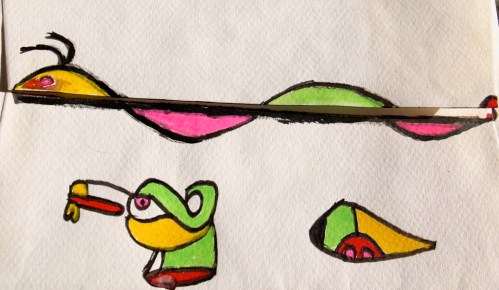
Columbus Interviewed by Bosch

img_0186

Christopher Columbus
Interviewed by Hieronymus Bosch
on His Return from the New World

“Winged creatures came with the dark,
their human faces cast in the features
of people I knew and loved.
Subtly transformed, they seemed reborn.

Their leathery wings
creaked like horse harness
and the “Splat!” of their excrement
was a slow drum beaten to a gibberish
march of dream after dream.

What could they portend?
My sister, nose stretched to beak;
my brother, lost at sea,
his eye teeth now enlarged
to a vampire’s fangs.

Each nightmare drew something
dark from my past, dressed it in fiendish garb,
and flew it with a guide-line:
a kite’s umbilical cord attached to the shadows
shifting above my bed.”

People of the Mist 10

img_0146-2

7:45 AM

Bare knuckles rapped against the frame of the open door and Mario stood there, blocking out the sunlight.

“Come in, Mario,” Tim said, hiding the medallion under a serviette that lay on the table. For some reason, he didn’t want the handyman see the medallion; but it didn’t matter, for Mario shook his head.

“It’s a pig day,” he announced from the doorway.

“Why is it a big day, Mario?”

“Not a big day, a pig day, you know, the day when you collect all your left-over food and I take it home to feed my pig. Sure, you remember.”

“Ah yes,” Tim sighed. “A pig day it is. When are you leaving?”

“I leave in about an hour. I just want to give you time to gather all your scraps. Then I will put them together with all the other people’s scraps and I will offer them to my pig.”

“How is the pig?”

“She is well, very well, and getting very fat,” Mario choked back what might have been a sob. “Soon I’ll have to sell her. I can’t stay, I must go now.”

Mario ducked his head and huddled away to the next apartment where he knocked on the door and Tim heard echoes of an almost identical conversation.

The sánate bird again scraped his knife-blade along the grindstone outside the window as

Tim divided the kitchen waste into two different bags, labelled edible and non-edible. When the bags were packed, he took the edible waste down to the courtyard.

Henry, the American missionary who had arrived here several months ago, stood by the container that Mario had left out for the pig food. Back in the States, Henry had made a fortune from the evangelical trade. Thousands of ardent listeners sent him the money he needed to build special projects in the good name of the Lord. In the Lord’s Name and to do His Good Work and spread His Holy Word, Henry owned a TV station and a Radio Station. With money to spend and the good word to spread, he had already involved himself in several financial transactions here in Oaxaca. The local people asked many questions about him, more often than not behind his back.

His latest plan was to develop The First Temple of the Rising Prophet. Nobody knew what this sect did and to find out, one had to become initiated into it and swear the vows of obedience and secrecy. Henry was founder, chief preacher, and high priest of the First Temple and he every day he tried to persuade all the foreign tourists who owned American money to join his new church.

“Are you feeding Maritormes, too?” Henry raised his hat as he greeted Tim.
Maritormes?”

“Yes, Maritormes, that’s what Mario calls his porker. Do you think it’s named after his mother-in-law?” Henry’s accent made the name sound like Merry Torment. “It’s a funny name for a porker.”

“How is the pig?”

“Doing fine,” said Henry, “and almost ready to be slaughtered and sold. Sssh! Here comes Mario. He gets weepy about his porker, you know.”

Mario walked across the courtyard and took the bag full of edible garbage from Henry’s hand.

“You don’t have to sell the porker, Mario,” Henry had held this opinion since he first heard about Mario’s pig. “You could raffle it. Then you could slaughter it and you could sell tickets for that too. I’d help you to sell the tickets. After the slaughter, you could do a barbecue, real American style, and my fellow First Templars could come round and eat. At ten bucks, US dollars, for each Templar, plus the lucky people we’re in the process of converting and persuading, we’d make a load more money barbecuing than selling, you know.”

“In my village we raise our pigs by hand and we don’t barbecue them,” said Mario with a great sadness in his voice. “That would be like sacrificing a friend.”

“There’s a first time for everything, you know,” Henry rubbed his thumb across his index finger and held the imaginary money up for inspection.

“I don’t think you’d all turn up. Once you saw the pig being slaughtered, you wouldn’t want to eat it. It isn’t everyone who can witness the slaughter of a pig.”

“He’s right,” Tim said. “I’m still tormented by my first memories of a pig slaughter and I can’t forget the anguished human squeal it gave as the knife pierced its neck. Lots of tourists feel sick as soon as they see the first drop of pig’s blood dripping off the knife-blade.”

“Anyway: how could you eat my pig?” Mario’s voice held a rebellious note. “You’re not cannibals. And you all might as well be related to it because you’ve been eating the same food.”

Henry considered this remark in silence then the First Temple Preacher shrugged his shoulders and tried again.

“For you, Mario, we’d all buy tickets. Then you could roast the porker and we’d all come to the party. No mescal, mind. I don’t want any of my people tempted into the evils of alcohol, you know.”

“But you drink alcohol. I saw you with an open bottle of wine the other night.”

“Well, what do you know? You saw me drinking wine, did you?”

Mario nodded his assent.

“You know what, Mario, that must have been Saturday night,” he hummed and hawed for a second. “You know, that’s right; I remember now. I was testing the altar wine. The Prophet’s blood flows thicker than water, my friend, as you well know. And remember, the first miracle that The Prophet performed turned water into wine. But the members of my Temple don’t drink wine anymore, not outside church, not now that we know it’s the Good Prophet’s blood, you know.”

“You eat blood pudding. You eat pig’s blood,” Mario flexed the muscles on his forearm. “Anyway, I can slaughter my pig but I couldn’t eat her. I feed her every day. For me, she’s like one of my children,” Mario took a tissue from his pocket and dabbed at the corner of his eye

“Wait a second, Mario,” Tim forced himself to sound positive. “Cheer up, Mario. You’re selling the pig in a good cause.”

“I don’t know about that,” Henry resembled a dog with a bone and he wouldn’t let go. “After feeding it every day, he sells it to be slaughtered. Then it’s turned into bacon and sausages and blood pudding, to be consumed by strangers. I heard tell once of a man who was sold to strangers for 30 pieces of silver. When you get your 300 pieces of silver, Mario, or whatever you get, I hope you won’t hang yourself from a tree.”

Mario’s face turned very red. He wiped his eyes in his tissue, took Tim’s bag of edible garbage and shuffled away with the two bags in his hand.

“Henry,” Tim stretched his hands out, palms up, towards the American as he spoke. “That wasn’t a nice thing to say. I think you’ve upset him.”

“I wonder if he kisses the pig on the cheek before he turns it in?” Henry stood there scratching his head with one hand

“Isn’t there something about charity in your church along the lines of ‘faith, hope, and charity, and the greatest of these is charity?’”

“You know, now I think about it, there is. And now I’m going to be very charitable to you. I know how much you’ve been suffering, don’t ask me how; and I know how lonely you are; again, don’t ask. Why don’t you become a Templar and join the Temple? You’ll be in on the bottom floor and there’s plenty of money to make. And this should get you interested: we’ve been signing up some great looking women. I know for a fact Marisa would like to see you there,” Henry gave Tim a wink and a nudge, but Tim didn’t wink back.

“She’s a fine woman, Henry, and one day she’ll make somebody very happy; but today’s not the day and I’m not sure that I’m the man she deserves.”

“Look: we can double everything up. Think about it: we buy Mario’s porker and then we barbecue it; and then we celebrate your joining the Temple with Marisa, all on the same day. All your friends, all Marisa’s friends, the people from the compound, Mario’s friends, the Templars: we’ll make a fortune. Tell you what: marry her and become Templars together and you can have half the profits from the barbecue as a wedding gift. What do you think of that?”

“And what, pray, does Marisa say about all this?”

“I haven’t asked her yet; but I reckon she’s up for it. She’s as ripe as a plum and boy, you do need a woman; believe me, I can tell.”

“Henry, if I need a woman, which I don’t, I am quite capable of finding one for myself, thank you. I don’t need a marriage broker.”

“That’s not what Mario thinks; and for once I agree with him.”

“Henry, please tell Mario to leave well alone. And as for you … and your charitable offer … well … I must admit … you have left me speechless with your, ahem, charity and, uh, generosity.”

“Don’t thank me now,” Henry rested his hand on Tim’s shoulder. “I’m just getting started, you know. You haven’t seen anything yet,” he winked at Tim again. “Trust me. But don’t trust them, any of them. Mark my words, they’ll betray you. And then you’ll be in trouble.”

He started to whistle and walked towards his apartment. Tim shuddered as he put words to the tune: “Matchmaker, matchmaker, make me a match.”

Writer’s Block: Wednesday Workshop

IMG_0182

Writer’s Block

Every day, well, almost every day, I meet people who tell me that they cannot write anymore. They have abandoned their current project. They sit in their work space and stare at blank screens or empty walls. They have come face to face with the dreaded Writer’s Block.

While some consider Writer’s Block to be an actual illness, others flaunt it like a flag or a badge of honor:

“Don’t touch me — I’ve got Writer’s Block: I wouldn’t want you to catch it.”

“I’m having a bad week: I’ve got Writer’s Block.”

“Sorry, I can’t make the writer’s meeting, I’ve got Writer’s Block.”

According to Wikipedia, “Writer’s block is a condition, primarily associated with writing, in which an author loses the ability to produce new work or experiences a creative slowdown. The condition ranges in difficulty from coming up with original ideas to being unable to produce a work for years. Throughout history, writer’s block has been a documented problem.”

We have probably all experienced the sensation of being unable to write, unable to think, unable to continue. As an academic, I found that something similar happens frequently in examinations with young students whose minds suddenly go blank when faced by a white page and an awkward question. This form of Writer’s Block comes at the most unfortunate times. Students need to be switched on just when their minds switch off. And something similar happens to writers.

Examination Block can be overcome. In many cases careful preparation for an exam will reduce or eliminate examination block. These preparations may well include correct note-taking and relevant revision procedures. There should be no last minute all-night study the night before the exam and a good night’s sleep, proper food, and water are essentials. Appropriate physical exercises before the exam starts are also useful as these make the heart beat and the blood flow. All these things prepare both body and mind and free the student for that most important task: the struggle with the blank page and the awkward question.

Will a similar set of preparations work for those who suffer from Writer’s Block?

In order to answer this question, I would rather take a different approach. Instead of seeing Writer’s Block as a physical / mental presence that stops us writing, why not look at it as an absence that can be overcome? What can we call that absence? Personally, I look upon it as an absence of creativity. If the creativity isn’t there, then writing creatively won’t happen. So what do we do?

Let us define creativity. For me, creativity is the expression of the creative principle that dwells within all of us. It is there, within us. We may suppress it or we may let it be suppressed. We may ignore it or we may deny it: but it is still there. It is always there. Sometimes it is beaten out of us; or we think it is. But it is still there, beneath the surface, waiting to be called on. The Roman poets spoke of it as Deus est in nobis … the god that dwells within us.

Creativity, for me, is like a river that vanishes underground and then reappears: it will be back.

The most important thing in my opinion is what you do when you’re not writing, what you do when you’re faced with that wall of blackness, what you do when you stare at that blank screen and nothing makes your fingers dance on the key board.

Here’s what I do. I make up my mind not to force myself to be creative. Forget about writing. Do something else. Ignore all idea of Writer’s Block, or the End of the World, or the Imminent Disaster of not being able to write. It may take a mental effort, but forget about it.

Now do something else, something positive. Different people respond to different stimuli. Here’s what I do.

(1) I read books
I read other people in their creative moments. I love reading people who write in other languages that I speak and read, because my own mind tries to recreate their images, their stories. This re-creation is a form of creation in itself. New words, new ideas, new combinations, rise to the surface of the mind, like bubbles on a river.

(2) I color and draw
As any who have seen my drawings know, I cannot draw. However, I can take a line for a walk. And that’s what I do. Then I color the spaces I create. My friends thought I was wasting my time and I believed them until I read one of Matisse’s sayings: “My ambition: to liberate color, to make it serve both as form and content.” Voilà: I have my raison d’être. Nature abhors a vacuum. When you create a space, color and meaning rush in.

(3) I take photos
The capturing of a moment: a sunset, a new bird at the feeder, deer wandering through the garden, a black bear visiting, rain on a spider web, sunlight through a prism, a cat made out of cherry stones … the re-creation of the moment is the creation of the memory. More bubbles flow on the surface of the stream.

(4) I go for a walk, look at nature and the world around me, people too
It is incredibly important to do this. A visit to the local coffee shop, a walk around the super-market or corner store, a seat in the park on a sunny day … just be yourself, believe in your existence, watch things as they happen, relax, look and listen, empty yourself, let the world flow back in … look at the ducks on the lake or the goldfish in the tank … more bubbles on the water, more ideas floating down the stream …

(5) I listen to music
De gustibus non disputandum … we can’t argue about taste. Where music goes, each person must make their own choices. The music I like fills my mind, relaxes me, flows out when it ends, takes my mind for a walk and leaves … a vacuum … into which dreams and colors, words and ideas, build like clouds …

(6) I cook
Cooking has always relaxed me. Sometimes the repeating of an old recipe helps clear my mind. Sometimes I have a need to invent something new. Hands and mind occupied, the secret, sacred underground river of creativity flows on …

(7) I sew
Last summer, an unexpected event led me to join a quilting group … oh what fun … a man quilting among a dozen women … I learned so many things … so many different ways of looking at the world … so many concepts that I would never have dreamed of on my own … Sewing runs in the family: I still have my grandfather’s sewing kit … darning and sewing needles that served him for two years before the mast … that darned his socks as he survived in the trenches of the First World War … it bears his name and I use it with pride … and what memories arise in my mind as I choose the needle … his needle … the one that will lead me into the next adventure, be it quilt, button or patch …

(8) I keep a journal
… and come hell or high water, I write in it every day and have done so since 1985. That’s 31 years during which I have scarcely missed a day. The writing maybe banal, it may be nothing but a note on the weather or a comment on a sporting event … but it’s there … a vital challenge to the idea that Writer’s Block can take me over and stop me writing. This journal is 95% drivel … maybe more … but bobbing along the stream of words are ideas, verses, rhyme schemes, choruses, stories, flashes of inspiration, jokes, memories, magic moments, falling stars, … the secret is to catch these falling stars, to recognize these rough diamonds and to return to them and polish when the moment is ripe … and it will be, sooner or later … for bubbles are buoyant and will lift you to the stars.

(9) Free Writing and the Creation of Metaphors
I also use the journal for free writing and automatic writing. These techniques, drawn from the Surrealists, allow the mind to wander at random. While wandering, the mind creates an interior monologue or a stream of consciousness that in fact turns up a series of delightful metaphors that can be polished and re-used at will. When I use this style of writing, I am reminded of Dalí’s saying (again and as always, from memory): “I don’t know what it means, but I know it means something.” My own theory of metaphor is that the metaphor is defined by two (sometimes more) points and rather than settling on one or the other (as in a simile), the mind moves and flickers sub-consciously between the two extremes so that meaning is sensed, but rarely can be grasped or stated in definitive terms. Thus, the marvelous line from André Breton, quoted by Mr. Cake,  “The wolves are clothed in mirrors of snow” has, according to my theory of metaphor, four defining points, namely, wolves … clothed … mirrors … snow. All four of these defining points creates an image, a very personal image, in the reader’s mind. The mind moves quickly between each defining point and meaning is lost in the rapid shift from image to image. Quite simply, “the hand cannot grasp it, nor the mind exceed it.” This means we have to return, as readers, to the unconscious level where the metaphors were first created. Then: “when we no longer seek it, it is with us.” This same analytical exercise can be performed for each line of Breton’s poem. When we indulge in free writing, much of what we write can be abandoned. The secret is to recognize and rescue the little gems we so often find.

(10) I believe
Through all this runs a thread of belief … belief that the black cloud of despair will not win. The Writer’s Block will go. Creativity will never be lost. It is there, beneath the surface, always ready to be contacted, waiting to rise and take you over again. And all too soon and quite unexpectedly, one form of creativity slips into another and the creative writing (it never really went away because of the journal) comes back.

Writer’s Block: it does exist. It’s how we deal with it that’s important. Creativity rules: forget Writer’s Block and let creativity and the multiple ways back to creativity grow and flow. Sooner or later the clouds will lift, the sun will return, the block will unblock and the words will flow again.

Remember the words on the Roman sundial: Horas non numero nisi serenasI count only the happy hours. And remember: the clouds will lift, the sun will return.

Trust me.
And believe.

Comment:
I first posted this entry on 17 August 2016. Since then it has received a number of hits and comments. Today, I have revised it and tightened it slightly, but the main ideas remain the same. I will try and continue with my Wednesday Workshops on a regular basis throughout 2017. Wish me luck.

Contract: Flash Fiction

IMG_0178 3

Contract

The door to the Principal’s office opened just as Tammy approached, hurrying because she was late for class. Tom, her Department Head, stepped out and stood in her way.

“Tammy,” his tongue swiveled around his thin lips in nervous fashion. “I’m just talking with the Principal about your new contract. Come in,” he extended his arm and shepherded her towards the open door.

“Not now,” Tammy replied.  “I’m late for class. “Can’t it wait?”

“Strike while the iron’s hot,” Tom showed teeth yellowed from tobacco. “We’ve got a great deal for you. Come in, come in.”

Tammy found herself face to face with the Principal.

“Tammy, my dear, we’re so proud of you,” the Principal flashed a row of crocodile teeth, two of them gold-capped. “I have some papers for you to sign.”

“But, I’m late for class and …”

“I know, don’t worry. This won’t take a moment,” Tom winked at her as he and the Principal led her towards a typewriter that sat on the desk with a blank page and two carbon copies inserted in it.

“Here, at the bottom of the page, just sign here,” Tom pointed.

“But it’s a blank page. I can’t sign a blank page,” Tammy stammered in response.

“You’ll see it when it’s typed and signed,” the Principal assured her. You can always change it later.”

“Can’t I come back after class?”

“I’m afraid not,” the Principal frowned. “I have an important meeting in half an hour, with the school board, and you’ll still be in class. This must be signed now if it’s to get board approval.”

“But you said … you said I’d only be here for a year …”

“We’re very pleased with you,” the Principal flashed the sunshine of his teeth. “We want to keep you here.”

“Very pleased,” said Tom. “This is a first class, independent school run, as you well know, on a non-profit basis. Only the children of the rich and privileged come here to study,” he paused. “And some of them come here because of you. That’s why I’m recommending you for this new and improved contract. I signed my first three-year contract this way, didn’t I?” he looked towards the Principal.

“You did indeed,” said the Principal. “And just look where you are now: Head of your Department.”

“A three-year contract …” Tammy blinked and ran her tongue over her lips. “I wasn’t expecting that. I thought a year … thank you … but …”

“No buts. Jobs are scarce nowadays, particularly in your field,” Tom looked at his watch. “Time’s getting on. You don’t want your students walking out of your class, do you? Here you are now: just sign here,” he handed her the pen he held in his hand.

“You’d better be quick,” the Principal said. “This offer may not be here tomorrow and … my goodness, look at the time. You are running late.”

“Sign,” Tom told her. “I signed and I never regretted it. Remember, we can always change the wording later.”

“Drop in after class,” the Principal smiled. “It will all be approved by then and you can read it and we’ll modify what you want.”

Tammy sighed and signed.

The Principal and the Department Head ushered her to the door.

“Hurry,” they exhorted. “Run. You don’t want to be late.”

Tammy ran to her class.

The two men watched her go. Then they went back into the office, shook hands, and grinned at each other.

Tammy never saw that contract. She stayed at the school for three more years, as she had promised, but in all that time she never got a pay raise and the not-for-profit school board never allowed her to join the employees’ health and pension plan.

Were you the one … Flash Fiction

IMG_0240

Were you the one …

… were you the one who awoke that morning at my side and heard with me the hammer blow fall on an echoing anvil in Oaxaca, in the central square when the rope slipped off the church bell and the priest and an altar boy, an acolyte dressed in black and white with a nut brown face, climbed into the church tower and when the priest said “now” the little boy struck the hammer against the bell’s anvil and “again” said the priest, and “again” and the cracked church bell lurched into its hourly cry of grief and morning, seven blows on the anvil, and a stray dog barked at those domestic birds whose beaks dug deep for the sun at dawn on our neighbor’s rooftop …and a cockerel cried out in the early morning, “cock-a-doodle doo, wake up you sleepy heads, wake up, do,” and the roosters found daylight buried in parched earth, and brought it skyward shining on their beaks, as thin cracks sprang out from the egg-shell sun like crazy paving as the yellow yolk of sunshine crept out from the cobbles down in the street and the Russian egg cup, doll after doll, unfolded daylight as the hammer’s silver spoon descended once more on this frail, egg shell world as our dreams shattered … and where now are those dreams of moonlight raked from a village pond as the orange spilled its life-blood to fill our crystalline goblets with its thick rich morning liquid as fierce and sweet as sunshine sacrificed on a branch and rain from a far-off cloud speckled the tree outside our window with radiance and a thousand rainbows all held in tiny diamonds that balanced and swayed at the branch’s edge then trickled and fell to form freckling pools between the cobblestones and even there the arco iris was multiplied, again and again, a thousand times … and the restaurant next door, with its semi-circular rainbow scarf and below it a painted deer on a decrepit wall, and Cuauthemoc was here, his burnt feet held to the fire that burns within us all, and that mangled man was nothing more than a string quartet of flesh and bone created from a ball of dough and baked in the oven in an earthenware dish with currants for eyes, a raisin for a belly button, lemon rind for a mouth, orange peel for hair, while the white bones stared stark naked from the burnt-out flesh at the end of his perished feet … and the man in the mirrored moon held up his hand to trap the wind as a falling leaf settled in the secret web between index finger and thumb and the cat’s cradle on his fingers bound us together like birds in a spun metal cage … the sparrow’s mighty choir chirped at the roof of the circus tent and animals ran wild all goosey, goosey gander, up and down, and nowhere can I now find my lady or her chamber, for they have gone, and with them went all hope, and hope being lost I ran in circles on the sand, my one foot dragging me inwards, and drawing me closer, ever closer to the rising tide, as night overwhelmed day, and dark soldiers invaded the shadowed beach, and where, oh where, did my little dog go, the dog I lost when he chased a seagull out into the bay and into the quicksand and he never came home and here I am alone in my loneliness wandering like a lost dog in ever-decreasing circles, round and round the central square, without you now, one step, two steps, and who will now tickle me under the chin with a buttercup, and who knows if I’ll ever eat butter again, as the tide climbs higher and the sea grass on the dunes is smooth and brown and cuts like glass with its withered, distorting mirrors of stark, staring eyes standing out in welcoming doorways with dark hands and even darker voices calling me in, again and again “are you looking for love, my love?” and yes, I am, I do seek love, I have always sought it, but I have sought it out in the open street, in the open square, in the fresh air, or indoors, where incense and candles burn, and the sun of god is nailed to his lump of wood or chained to his pillar and the Roman soldiers raise their whips to their lips and their kiss is the kiss of death, and I still search for love and my long lost dog as black eyes penetrate from the blackest paint where Satanic witches spoon salt soup between wrinkled lips, dark open holes for their mouths, and their eyes gouged pits in slatted, wooden faces, and they hover over the deaf man’s table in La Quinta del Sordo or stand shoulder to shoulder with Adam and Eve next door in Hieronymus Bosch’s bourgeois hell of furnace, flame, and factory, where the hot flesh catches fire as the feet are turned to the flame and Cuauthemoc burns, the whole world burns, and my soul catches fire as factories swarm with sparks of black imps, burning, dropping from the skies like fire-flies tumbling in a satanic dance, falling away from the heavenly meadow, lighting a way to the skies and the devil, too, is lost and bewildered, a Guy Fawkes impaled on his wooden stake at the bonfire’s tip and it’s November the Fifth, and the whole world is full of spinning star-sparks burning their Van Gogh holes through the black velvet fabric of the dark night of my still-suffering soul …

Comment:
This is a re-write of what I posted earlier today. It is the same piece but it is slightly shorter, more polished, and better focused. It also now has a clearer narrative line with less jumping between metaphors and a cleaner, clearer sequence.

Tomorrow

DSC02478.jpg

Tomorrow

Tomorrow, early, my love, you’ll fly away. Today, all tense and stressed, your foot in the stirrup, as Cervantes would say, the anxiety of the journey on your back, you walk around the Beaver Pond where red and yellow leaves abound. I know you are hoping to see, once more before you leave, the Great Blue Heron that was here last week. Some ducks remain. I can see them standing on the water, flapping their wings, inflaming the wind, keeping themselves warm, not looking as if they really want to fly.

Alas, there are no beavers now. An abandoned lodge, the grass on its roof turning brown and dry,  lofts white sticks into the sky, but the waterways are clogging and the beaver have gone. Drowned tree trunks, beaver-gnawed and languishing, grow tiny clumps of grass and weed. Sometimes, they join together and form a miniature island that will grow at last into a grassland. The deserted lodge reminds me of our home, soon to be abandoned by the life and soul that animates it and keeps it alive. It will be sad and lonely living there without you. I know I will have the cat for company, but that’s not the same. I think I’m in charge of her, but I wonder sometimes if you’re leaving her in charge of me.

A thin grey woven webbing garlands one moribund tree. I don’t like tent worms or their equivalents. Every year we face a different invasion of this worm or that and the trees stand shocked by crawling creatures that infest their branches and build their silk cities up into the sky. I hate it when those dangling inhabitants, escaping from their cocoons, swing from low branches and twine silk threads around my face. Give me any day a fresh green frond caught by the morning sun in early spring, or else bright autumn leaves so soon to fall.

I love American Goldfinches when they sing that last departing song. I love most of all the occasional visitors that wing up north on the wings of a summer storm. Do you recall the Indigo Bunting that perched in the Mountain Ash just outside our kitchen window? He had the look of a lost bird and his call was more a cry of help than a birdsong. You took such lovely photos of him as he sat there, looking this way, that way, anyway for the way he needed to go home … and those two cardinals, orange the one, bright red the other, standing beneath the feeder, so bright against the early snow.

The hunting hawks give everyone a fright. They perch on top of a power line pole then step off into space to alight, claws first, on some poor songbird trilling away, quite free from fear, his unfinished symphony of song. Claws first? I gaze again at the photo you took of the Sharp-shinned Hawk that settled on our porch that day it rained. Claws? The massive yellow talons are high grade weapons fit for any war. I pity the poor bird clasped in those claws and brought to earth or lifted high into the sky, a feast for the marauder.

It’s getting late, my love. You walk towards me out of the woods like some lost spirit returning to this earthly world from some spiritual sanctuary. The season is ending. Thanksgiving is close. It will soon be time for you to pack your bags and go. Three silent wishes for you my love: enjoy yourself; don’t forget me … and don’t stay away too long.

Comment:
This piece goes back to the Fall of 2016. Clare and I visited the Beaver Pond at Mactaquac the day before she left for Ottawa. I sat at a picnic table and watched her as she walked through the woods and around the pond. ‘Parting is such sweet sorrow’: she didn’t want to leave me and I didn’t want her to go, yet we both knew how important it was for her to visit our grandchild for Thanksgiving. Time apart is good: it makes us realize how much we miss each other. For me, above all, it is a reminder of everything that gets done around the home without my ever noticing the care and love that is poured into each moment of every day. Having to provide that care and love for myself is an object lesson that makes me so thankful for the seemingly simple blessings Clare has brought to me throughout our married life …

Indigo Bunting, for Meg:

For you, Meg: photos, by Clare, of our second Indigo Bunting.

IMG_0206.jpg

He’s rather handsome. We usually get them in from the States following a strong south wind or  a summer storm.

IMG_0207.jpg

Great Blue Heron, for Tanya:

He was right over the garden: beautiful. We don’t often see them up here as we are on the far side of the hill from the river. Must have been raiding a neighbor’s goldfish pond.


IMG_0231.jpg

Terza Rima

img_0188
Terza Rima
 Apologia pro verbum meum
Dear followers of my WordPress Blog: sometimes
I write what I do not mean to write
and say what I do not mean to say. Rhymes
make things clearer, for I puzzle what I might
say, and plan ahead so an awkward word
doesn’t intrude. Words, birds in flight,
bright as postage stamps across the absurd
white snow of a page or a digital screen:
when I think about it, I assume about a third
of what I say, I really mean. Who has seen
the early morning wind drifting our thought cloud
across trees and lawn, shadows cast on green
leaves of grass as we think our thoughts aloud,
each thought a pea in a pod, as some we clasp
between finger and thumb while others crowd,
and the loud, uneasy word slips from our grasp
to wound or injure or otherwise to hurt and maim.
It’s not my aim to do this. My word is not an asp
or a viper or a screw to be driven. I lay no claim
to hurt and yet sometimes a word slips sideways
and does not say what I mean it to say. I aim
to please, to tease, to provoke, in so many ways
and yet I often hurt where no hurt is intended.
If I have done you wrong and my word displays
unintended ends, forgive me: let all rifts be mended.
Comment:
Terza Rima was, for a long time, the chosen verse form for letters and epistles: the epistolary form, in fact. The rhyme scheme is very flexible and easy to maintain and the syllable count is also relatively easy. As for the length of the letter, well, that is entirely up to the writer. The one that I have chosen here has seven tercets and ends in a quatrain. The quatrain is a standard “stitch up” with which to end. I have used the epistolary form on many occasions, especially when sending postcards and letters to friends. Add it to your poetic arsenal. You will not regret doing so.

Claustrophobia

IMG_0291.jpg

Claustrophobia

“I’ve got to get out of here.”
“Why?”
“I can’t breathe.”
“Where are we going?”
“Anywhere.”
“Are we going to Gran’s?”
“Why not? Yes. Pack your bag.”
“What about Dad?”
“What about him?”
“Aren’t you going to tell him where we’re going?”
“No.”
“Why not?”
“Because he doesn’t care. If he cared, he’d be here.”
“Maybe he’s had an accident?”
“He didn’t have one last night, or the night before. He just doesn’t care.”
“We can’t just go …”
“We can.”

She called a cab and when it came, they turned the lights out in the house, and shut the front door behind them. Then they got into the cab. The cabbie turned to her and spoke over his shoulder.

“Merry Christmas, and where would you be going, Ma’am?”
“The station.”
“Bus or train?”
“I don’t care. They’re both the same.”

The cabbie shrugged and pulled away from the kerb. The bus station was closer and that’s where the cabbie left them. Mother and son stood there for a moment, under the station lights, looking at the coaches that squatted there, parked in regular lines. Then, mother and son, they walked into the ticket office.

“What time does the next bus leave?”
“Where do you want to go?”
“Home.”
“Where’s home?”
“Swansea.”
“The next bus for Swansea leaves in twenty minutes.”
“We’ll take it.”
“Single or return?”
“Single. Two tickets.”
“You should buy a return ticket; it’s cheaper.”
“We’re not coming back. Not this time.”
“How old’s the boy?”
“Seven.”
“He can travel half price.”
“One and a half then, singles.”

It was December 23rd, her own mother’s birthday. Mother and son sat together on the dark, empty bus. The cold seats chilled them as they waited  in silence. The boy looked out the window and coughed.

“Will Grampy be there to meet us?”
“No.”
“Doesn’t he know we’re coming?”
“No.”
“Does granny know?”
“No.”
“Mum, why are we going?”
“It’s granny’s birthday today. We’re going to give her a surprise.”

Two hours later, the bus deposited them in Swansea. The night had filled with heavy clouds and promised snow.

“Can we take a cab. mum?”
“There’s none here. We’ll have to walk.”

They walked side by side down the well-known streets. Christmas lights adorned the shops and they walked through alternate pools of light and darkness.

“Mum, I’m tired.”
“Give me your bag. We’re nearly there.”
“But mum …”
“I can carry both. Hold on to my arm.”

They kept on walking. After a while, they stopped beneath the streetlight outside the old family home and looked up into the street light’s glow. The first snow-flakes danced down.

“Can we go in now, mum? I want to see Gran and Gramps.”
“You go in. I’ll be with you in a moment.”

She watched her son climb the steps to the front door. He lifted the old brass knocker and banged it down. After a moment, the front light came on and the door opened a crack. She stood beneath the street lamp, inhaling, taking the chill air deep into her lungs. She felt the tight bands in her chest start to loosen. For the first time since this time last year, she felt free

Warning to the reader:
Raw material, still under revision, and probably needs lots of revising. I look forward to your comments. In some ways, this is my take on A Child’s Christmas in Wales. Not quite how Dylan Thomas saw it; more a sort of … well, you work it out for yourself!

Last Night’s Reading

IMG_0146 2.jpg

Last Night’s Reading

I can hear the questions now:
“How do you feel
when he writes about you?”
“What do you think?”

The question of how
the listener feels doesn’t enter
the reader’s mind
when it imprisons
this furious god
who drives us onward.

We carry a picture within
our hearts that corresponds
to an internal reality
that has nothing to do
with the world around us.

At first, we impose.
Next, we learn to shape.
Then we realize we are the ones
who’ve been shaped
and we learn to share.

Only then do we understand
that what we carried within us
like the mother carries
a baby kangaroo in her pouch,
was not at all what we thought it was.

“Mankind can withstand
a small amount of truth,”
some poet wrote, Eliot, I think.
And what we release hops out,
floppy ears, long legs, bounding,
bonding with its own sweet music.

Candles

img_0136

Candles

I love the flicker of flame,
the yellow light dancing
shadows on face and plate.
Let’s clear away the dishes
and bring the table back
to its pristine state: grained
wood. Now let’s talk of old
times back home when coal
fires roared and drafts ran
from dark corners, raising
hair on necks and sending
shivers down spines. It’s so
easy to believe in ghosts
when night winds howl
through windows, dogs bark
at nothing, houses are older
than families, and the land
snuggles down to sleep
in its winter blankets.
Beware of the sudden draft
on the oil lamp’s frail chimney:
cold will crack the glass, sending
us to bed by candlelight while high
on corridor walls old folk come
alive and frown down from
their sepia photographs. Cold
and frightened by their restless
afterlives, we shiver in the grave
cloths of our damp beds.