Silence

img_0196-2

Silence

When I wait for words to come
and they refuse,
I know that silence is golden
and spreads its early morning sunlight
across the breakfast table
where yellow butter melts on hot toast.

Light from the rose window in Chartres
once spread its spectrum over my hands
and I bathed in its speckled glow.

My fingers stretched out before me
and I was speechless;
for in such glory,
mortal things like words cease to flow.

So much can never be said
even if it is sensed: fresh coffee,
poutine à pain, bread baking,
flowers  bursting into bloom,

the sense of immanent beauty that fills me
each time my beloved enters the room.

People of the Mist 18

img_0146-2


11:00 AM

            … hard baked loaves of stone … hot cobbles beneath the feet … the burning street forced upwards through the shoe leather to scorch the feet … the sun’s orb an irresistible hammer beating the strength out of the sweating body … the heart sucked dry … the lungs shriveled … a man dehydrated … already dried up by the baths … from the inside out …

Everything seemed different to his distorted vision. Translucent people, pale ghosts of themselves, passed before him and wandered across the street, shadows in a dream cast against a cave wall. Tim walked to the central square and entered the cathedral through the same carved glass doors in which he had seen his father’s image, but his father was no longer there. Wary of flames and flickering candles, Tim stood in the dust-laden beam of sunlight that fell from a stained glass window high in the roof.

Wave after wave of colored light broke across his face and played fragmented games upon his hands. He inhaled sunshine and felt the sea-surge of a body being reborn. A new man, he emerged from darkness into light, a spiritual being, neither of this world nor yet of the next. The colored light danced its chiaro-oscuro upon the surrounding walls and he felt soft sunlight flooding into him.

            … inside massive stone walls … candles … crucifixes … paintings of saints … statues … carved wooden images … outside in the sunlight … alebrijes … staring eyes … wagging tails …  protruding tongues … their spirits breaking through the wood … turning from darkness into light … within the man’s head … once open doors slowly closing …  keys no longer turning in locks … unwound clocks no longer ticking … cobwebs gathering in forgotten rooms … flowers on the altars… nochebuenas with their single and double petals … crimson and cream … cempasúchiles … marigolds lighting  a golden walkway to guide the dead … loved ones returning to visit the living …

Standing in the cathedral, drenched in a rainbow shower of light, Tim’s mind drifted in and out of sun and clouds. All around him he saw secret worlds opening like oysters before his eyes. Flames through the candles made hard, crisp sounds, hissing and sharp, like the inside of an apple when strong teeth penetrate the outer skin. Candlelight brought an unexpected peace as its yellow bees’ wax light wandered over the altar.

Tim went to the chapel dedicated to La Virgen de la Soledad, the patron saint of Oaxaca. A girl knelt in front of the altar with a basket of flowers upon her head. With a click, wheels turned in his head and Tim realized that he had seen her that morning in the square in front of St. James. He didn’t want to disturb her prayers, so he tiptoed to the far side of the altar rail and started to kneel. As he did, the flower girl turned her head towards him.

Señor: I am so glad you have come. Please, I need your help.”

“My help?” Tim stood up and moved towards her. “Of course, what do you want me to do?”

“These flowers, I must place them on the altar. But the basket is caught in my hair. I cannot remove it. Could you …?”

“I saw you with a boy, this morning outside St. James, didn’t I?”

“Perhaps. My cousin walked with me until he slipped on the cobbles and could walk no more. He would have helped. Now there is nobody.”

“I’ll help. What must I do?”

“Take the weight of the basket and try to see where my hair is caught. You must untangle it, if you can. Then I can place the flowers on the altar as I have vowed.”

She knelt, motionless, an animal frozen in a trap. Tim lifted the basket and its weight shocked him: the stones within must have weighed at least twenty pound. As he lifted the basket, she winced and he saw where her hair had caught in the basket’s wickerwork.

“Can you hold the basket now?” he asked her.

She raised her hands and held it aloft. As she did so, Tim began to untangle her hair from the weave, a slow, difficult task. At last, the basket came free and the girl’s black hair fell smoothly into place.

“I hope I didn’t hurt you when I pulled your hair free.”

‘”Thank you and no, it didn’t hurt,” She took the basket in her hands and he opened the altar rail for her. She mounted the steps and placed the basket of flowers on the altar at the feet of La Virgen de la Soledad.

“There,” she bowed her head, crossed herself, and muttered a prayer. “My father will get better now.”

The girl returned through the altar rail and she and Tim knelt side by side in front of Oaxaca’s patroness.

“They say she will answer your prayers,” the flower girl looked weary and distressed. “She has worked many miracles for those who have walked the road. My cousin walked with me for a bit, but he was in great pain, so I sent him home.”

“Surely you could have finished the pilgrimage another day?”

“Oh, no, señor, it must be completed between the hours of six and twelve. My cousin should have helped, but I did it on my own. Señor, I must go now. It is time for me to change. I have completed my pilgrimage and now there is work for me to do.”

“Perhaps I can walk with you a little way?”

“Oh no, señor, that wouldn’t be right. I must go alone. But thank you.”

Tired, but full of grace, she got to her feet and walked backwards, away from the altar, not taking her eyes off the Virgin’s face. When she got to the chapel’s entrance she turned and left.

Tim knelt there in silence and thought of the strange things that seemed to happen in Oaxacan churches. Last Sunday he had gone to mass in La Consolación. The lady in front of him had opened her blouse and offered her breast to her youngest child who sucked there, greedily, throughout the service. The old man at the back held a roll-your-own smoke in the palm of his hand and closed his eyes in ecstasy as he inhaled the drug. Three dogs, tongues lolling, were pursuing a bitch in heat and she came into the church for sanctuary. The dogs chased her up and down the aisles as the high priest doggedly murmured the blessings that uplifted the hearts of the faithful: a bored acolyte passed the anointing oil and presented the sacred wine to the priest. Flowers and candles adorned the altar. When the old man from the back of the church stubbed out his smoke and knelt for communion, night breath lay whisky thick on the high priest’s tongue.

La Virgen de la Soledad stood tall on the altar wearing a black kirtle. Silver stars and planets swam through the dark night of the velvet that flowed down from her waist. Beside her, a young man with open, staring eyes hung from a rough, wooden cross. He recognized Tim and called him by his baptismal name, but Tim no longer knew how to answer. The young man had the jewel eyes of a flayed Mexican god, living forever, and never quite dead. Black blood flowed down the carved face and formed a river of coal dust waxed with carmine. The heavy smell of incense mingled with the smoke from the candles and transported Tim to an internal world in which time rolled on and on and lost all meaning.

… impressions … a nose here … a pair of eyes there … long black hair … a tree swaying to the music … a nose wrinkled in disdain … a black bible banged on a wooden table … a thin girl … a Cubist nightmare of female body parts … multiple pin balls released in a rush by an errant slot machine … light falling from high windows … stained glass … reds … blues … greens … smoke from a candle twisting in the air …
Birthday Poem

img_0165

Poem on his 73rd birthday

I won’t sit with my head between my hands
fearing the future or brooding on the past.

Each day is a bonus now, each sunrise a celestial
celebration, each evening a drawing down of blinds.

I welcome each sun with open arms and accept
the gifts it brings. Sunshine fills me with joy. It beams
like a beacon with the warmth of my joyous heart.

People of the Mist 7

img_0146-2

7:30 AM

Tim opened the gate and walked into the courtyard of his apartment building. A bird of paradise fluttered before him, its crested head suspended in mid-air. Earth-bound, it nested in a basket in the grapefruit tree. Mario, the handyman, and Marisa, the widow who did the laundry and cleaned the rooms, gestured as they argued.

Marisa had just caught an enormous chapulín. She grasped the grasshopper by its hind legs and held down its freckled, leaf-colored wings so it couldn’t fly.

“It poured with rain last night,” Marisa said. “I saw him here, in the courtyard. I caught him before he dry his wings and fly,” Marisa held out her captive for Tim to see. The chapulín had long grey-green antennae and the serious anthropomorphic face of a junior priest or a staid young scholar who would one day hold sway over a classroom filled with little children. Its wings vibrated as they changed colour adapting to light and shade.

“I’m going to call him Charlie Chapulín,” Marisa smiled at her own joke.

“Give him to me. I want to hold him,” Mario lifted the grasshopper from Marisa’s hand and trapped it in a cage made from his fingers. “I have kidnapped your Charlie Chapulín,” he said in a threatening tone. “But you can ransom him for a kiss,” Mario closed his eyes, puckered up his lips, and Marisa slapped him in playful fashion across the face.

“Thief,” she said. “It’s my chapulín.” She put her hand on the grasshopper that Mario now held and Tim wondered if he was going to witness the Judgement of Solomon.

“It will be our chapulín,” Tim declared, “un chapulín de equipo, a Team Tim grasshopper, first captured by Marisa, then recaptured by Mario, then accepted into the team by me: a veritable dream team chapulín.”

El Brujo would tell you to set it free, Mario,”Marisa smiled.

“Don’t say things like that, Marisa,” Mario frowned, drawing his thick, black eyebrows in together to form a crow’s wing.

El Brujo?” Tim snapped to attention. “What do you know of him? Tell me, please.”

“Say nothing, Marisa,” Mario urged her. “You know we don’t speak of that man, not in the presence of strangers.”

“But I’m not a stranger,” Tim protested.

“Maybe not a total stranger, no,” Mario conceded. “But you are a foreigner, and it is dangerous to speak to foreigners about our holy men.”

“Dangerous? Holy? In what way? Tell me.”

“We have already said too much,” Mario beckoned to Marisa. “Come, Marisa, we have work to do.”

“At least let the chapulín go,” Tim said. “It was born free. Give it back its freedom.”

“Born free, like those captive kings who now dance in stone prisons on Monte Albán,” said Mario, unwilling to relinquish his prize.

“Yes, Mario; born free, just like them,” Marisa smiled. “And one day their prison walls will be broken and they too will be free, as will we all.”

“Enough,” Mario opened the prison bars of his fingers and the chapulín flew.

“Ah well,” Tim said. “It’s time for my breakfast.”

“Your breakfast has just flown,” Mario flashed his white teeth and the gold filling sparkled.

“Mario, you are a brute,” said Marisa as Tim walked to the bottom of the stairs and climbed up to his apartment. “He wasn’t going to eat him.”

“I don’t trust foreigners,” Mario glared at Tim’s back and made a rude gesture with small and index finger. “He would have fried him in olive oil and eaten him with garlic.”

“Mario: stop that,” Marisa gave him a push. “Remember: it’s a pig day. You mustn’t be rude to foreigners on a pig day, especially those who live in the compound.”

Mario shrugged.


People of the Mist 1

IMG0137_1.jpg

People of the Mist
Oaxaca, Mexico

Prologue

 I saw my father this evening. I walked through the zócalo, opened the main cathedral doors, looked up, and there he stood, motionless. The lights shone on the engraved glass panels and illuminated him, as if he were some long passed saint come back to visit me. We stared at each other, but I couldn’t open my mouth to speak. The hairs on my neck stood on end and my hands shook. When I forced my mouth open, words stuck in my throat. He wore his best grey suit over a light blue shirt and a dark blue, hand woven tie. This was the outfit in which I had buried him.

Three old women, dressed in black, broke the spell. One stood in front of me and wouldn’t let me approach my father. She held a large bag of knitting in her hands and the wool spilled everywhere as she pushed me away. The second threatened me with a pair of scissors that she held in her left hand. The third shook a tailor’s measuring rod in my father’s face.  He nodded, smiled sadly, and they all turned their backs on me and hurried away out of the cathedral and into the square.

 I stood there in silence. Then, as the door snapped shut, I pulled it open and ran after them. The setting sun filled the square with shadows that whispered and moved this way and that, as if a whole village had come down from the hills to walk beneath the trees and dance in the rays of the dying sun. I stood on the cathedral steps and called out my father’s name, but I could see no sign of him among the cut and thrust of the shadowy crowd.

 I ran out into that crowd and pushed at insubstantial people who stood firm one moment and then melted away the next like clouds or thick mist. I came to a side street and saw real people, flesh and blood beings, a group of villagers grouped behind their band. I stopped as the village elder put a live match to the taper of the rocket he clutched between his thumb and forefinger. The taper caught on fire and as the rocket roared upwards the village band started to play a military march. Thus encouraged, the rocket clawed its way into the sky to explode with a loud knock on the door of the gods.

 Tired of grasping at shadows and afraid of this living phalanx of men marching towards me I went back to the cathedral and knelt at the altar of La Virgen de la Soledad, the patron saint of Oaxaca. Real wax candles stood before her altar, not tiny electric bulbs, as there are in some of the smaller churches. I put five pesos in the slot and lit a fresh candle from an ageing one that had started to sputter. For the first time in years I said a prayer, first for the soul I had saved from extinction by lighting my candle from his flame, then for my mother, then for the real father whom I had never known, and finally for the man I had just seen.

 Tim closed his journal, screwed the top back on his Mont Blanc pen, laid it on the table, put his head in his hands and sat there, thinking. Then he got up, went to the kitchen, opened his last bottle of Sol de Oaxaca, poured the quarter litre that remained of the mescal into a glass. Six wrinkled worms floated down through the yellow liquid wriggling as if they were live. He pulled them out with a spoon, popped them one by one into his mouth and swallowed them whole. They tasted of smoke and garlic but he knew they would bring him visions and dreams. Then he wrinkled his nose and swallowed the mescal in three fierce, burning gulps.

He coughed, blinked the tears from his eyes and went into the bedroom where he undressed and climbed into bed. The ceiling fan droned on and on like a large propeller on a long-distance flight. Sleep did not come easily, nor did dreams, in spite of the mescal. When the dreams did come, they built like thunder clouds and he entered them with fear and a strange kind of joyous expectancy.

Comment:
This is the prologue from my first novel, People of the Mist. Following in the footsteps of my two blogger role models, Meg Sorick and Mr. Cake, I will publish People of the Mist, chapter by chapter, on this blog, as I revise it. I am a poet, rather than a novelist, as you will see. Your comments will be welcome as I start this venture in the old year (2016) and plan to continue through the new (2017).

What if …?

img_0265-2

What if … ?
Secret Garden 5

Here, between the hedges,
snakes the maze.
We can see the entrance.
We know where the exit lies.
We can even see each other
on our separate paths,
but we can’t come close
unless we break the rules.

Faced by constantly forking paths
we play the “What if … ?” game.
There are no answers,
just a series of trials and errors
where right and wrong
are paths we may, one day,
be forced to choose.

Forced:
for we cannot stand here
motionless.
Sun travels sky,
casts shadows long over
labyrinth and lawn.
Fish rise to flies on the lily
pond and life slips slowly by
as we ponder each decision,
over and over.

Time’s up.
The uniformed keeper
moves toward us.
Jumping low hedges,
we meet, hold hands,
and hurry to the exit.
Behind us,
the keeper smiles.
He rakes our foot
prints from the path.
The gates click closed.

Comment:

Fifty years ago today, Clare arrived in Canada. A friend drove me to Malton Airport, as it was then, and we waited for her to clear Customs and Immigration. While waiting, I played the “What if …?” game. “What if she’s not on the plane? What if she doesn’t like the apartment I’ve rented? What if she no longer likes me? What if she hates it here? What if she wants to go home?” So many questions stormed through my head. There were no answers, just a series of trials and errors where right and wrong were paths we chose; and we chose to get married, to stay, and to make Canada our home. Fifty years later, to the day, the “What if … ?” game goes on. The playing field has changed, the game rules are different, it’s a whole new ball game … yet we still ponder each decision, over and over. We have changed, both of us, over the last fifty years together. Changed, yes, but deep down we are still the same, for some things never change. And we are happy to keep it that way. Oh yes: and we still hold hands.

Secret Garden 3

IMG_0150.jpg

Secret Garden 3

Good times, bad times, sun and rain:
only the robin knows what passes
through my mind at times like these.
Head on one side, looking at fresh-
turned earth for wriggling worms to take
to his new nest under the leaves, he’s not
telling anyone anything. So why should I?

“Once I had a secret love,”  but secrets
aren’t secrets when the heart is worn
on the sleeve or a shining ring adorns
the loved one’s finger. I remember
the warmth flooding through heart
and mind as I prepared for our secret
meetings. The Silver Gift Shop in Bath:
many’s the afternoon I waited there
while you finished your shift in Boot’s.

Then off to the Monk’s Retreat for sausage,
egg, and chips served in the frying pan
at the table: “Careful, my dears, it’s very hot.”
The Robin nods his head and winks a knowing eye.

There are voices in the garden. We lie
close to the ground hoping we won’t be seen.
Your state of undress is something
you’d want to hide from your mother,
even now, after a quarter of a century.
Would you encourage your daughter to make love
out of wedlock? We did. There: the secret’s out.

At least, I thought it was a secret,
but now, as I sit in the classroom
watching pair lovers, side by side,
I read so many signs I once thought
unreadable: sudden warmth in a smile,
a blush, eyes locking then looking
quickly away, a change in a person’s
breathing, hands touching lightly,
loves messages flashed swiftly
from eye to eye, along the secret pathway
that unites and ignites two souls.

IMG_0180.jpg


Your Voice

IMG_0196 2.jpg

Your Voice
Love poem

Still in the still of the rain
I sense you near.

The room is full
of the scent of emptiness
yet even the silence
turns my head.

The walls expand
to enclose the world.

With gaudy flags
on a colored map
I mark your progress
through my memory,
upwards and inwards
your progress to my heart.

A moth glistens in the circle
cast by my reading light.

Your stealthy footsteps
sound in the corridor.

A voice, your voice,
drifts through the night

Dream of Oaxaca

IMG_0165.JPG

Dream of Oaxaca

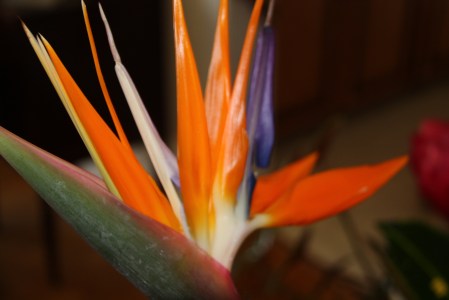
I can bring you a Bird of Paradise, but I cannot bring you the sounds and smells of Oaxaca. The pungent odour of the first drops of rain falling into dry dust, the tang of waxen candles burning in the cathedral’s dark, the high notes sung at the altar by the old woman, dressed in black, who sings each day, on her knees, before the golden images in Santo Domingo: these sounds and smells defy any words I can pen. Nor can I place on the page the bustle of the abastos, the bickering of rooftop goats, the barking and growling of the dogs who patrol the azoteas at head-height and snap at your ears.  Other things escape me: the salty taste of sweat, the heat and heaviness of the midday sun as its hammer falls vertical from the sky, the sandpaper touch of hand-hewn stone, cobbles hard beneath the feet, the visual impact of the revolutionary bullet holes still scarring the church where Benito Juárez got married and reminding the tourists that violence in Mexico is never far away. The silk smooth threads that run through the vendor’s carpets contrast violently with the harsh sharp tares still lodged in hand carded wool. Colors and scents: coffees and chocolates blending and blended in the open air-market, the spice stall with a hundred different kinds of peppers, the golden yellow flower of the gourd — flor de calabaza — as it floats on the surface of spiced soup or lolls luxurious upon Oaxacan cheese or tortilla and quesadilla. Such things are the substance of daily reality: I remember them well, but I cannot gift you with their taste, nor their smell, nor their sound. At night, strings of fireworks hang down the cathedral’s towers and, at the spark of a match, these castillos as they call them, burn. Cataracts of light flicker and flow as rockets claw upwards into the sky to knock on the doors of the slumbering gods. A bull’s head, attached to a wooden frame, bears fireworks that crackle and spurt fire as the bull charges at the gathered crowd. Sparks char cotton and wool, young girls shriek and flee, a striped, carved tiger emerges sparkling from the shadows and his eyes light up with another set of fires … But there is always something missing from these words. How much can I describe? How much am I forced to leave out? How close can I get to an imagined reality that is more imagined than real, more creation than memory? I live in a world that has forgotten poetry. I live in a world that has laid aside the great myths and replaced them with a media that misleads and falsifies. I live in a world in which the power and glory of words is used not to delight and educate, but to manipulate. I live in a treacherous world of lies and deceit, the world of Descartes’s evil genius, for not everything is as it seems to be and the people have been misled. But this world of ours is old, and older, darker powers than ours still dwell on this earth: a pinch of salt thrown over the shoulder, index finger and thumb pinched into a magic circle that wards off the evil eye, the traditional hunchback – el jorobado –, carved from jade, who packs our cares and troubles into his hump and carries them away … as I have been carried away, on this tide of creation that ebbs and flows, a virtual sea, a wave of autumn leaves that washes up to my door, then falls asleep, golden, brown, peaceful in the vacuum that is left by the wind’s sudden absence. So, for a while, after you have read these words, avoid all shadows, do not step on the black lines that divide sidewalk and pavement into squares, do not crush the elf’s dry bones hidden in a fallen leaf, avoid black cats, make sure the crow flies on the correct side of the road …  then find a quiet corner of the street where the leaves dance to the wind’s tune, and fall asleep to re-create your own life in dreams.

People Poems 4

img_0202-1

People Poems are dedicated to people who, for one reason or another, have distinguished themselves in my life. People Poem 4 is dedicated to Jane Tims who first encouraged me to start this blog. So, Jane: please accept this bouquet of flowers, just for you!

Jane is a wonderful poet who researches deeply into the past of New Brunswick. Her current project on New Brunswick schools and the early education system in the province takes her back in time to study the names and places on the old censuses. She then travels the back roads and visits the small country communities where the old often one-room school houses still exist. This is the research part. Then Jane imagines what life would have been like walking to those schools and working in them, in summer and winter. The result is an old world, re-created.

Other projects of Jane’s include the covered bridges of New Brunswick, all photographed, sketched, and recreated in verse. She has worked too on the fruit and vegetables of the province, all of them Within Easy Reach, the title of her latest book. An efficient and competent multi-tasker, Jane is also working currently on meniscus, a science fiction fantasy story in poetic form. I have had the privilege of reading an early version of the manuscript. In addition, I have heard Jane read extracts from it. It is a wonderful creation and I look forward to seeing it thoroughly finished.


img_0274

Jane is also a great artist and I love the drawings and sketches she includes in her books. Above all, I really enjoy her paintings. This one, Apples, she gave to me not long ago when Clare and I visited her in her studio home. It hangs in our kitchen beside my chair and reminds me of the beauty of art and the nature of friendship: light, kindness, generosity, and a love for the world in all its many forms. Thank you for being here, Jane: the world is a better place with people like you in it.