
My Top Ten Books
For Tanya Cliff
https://postprodigal.com/2016/07/14/top-ten-books-that-changed-my-life/
It sounds so easy, doesn’t it, to choose your ten favorite books? But really: it isn’t.
Clare’s great aunt made the best sponge cakes and rock cakes I have ever tasted. Her formula? Not weights and measures but a simple scale: the egg on one side, the flour on the other — and balance them.
How do I weigh a book?
I think in terms of authors rather than their individual books. For example, on one side of the scale place Les Fleurs du Mal of Baudelaire and on the other, his Petits Poèmes en Prose. Literary and cultural history would opt for Les Fleurs du Mal, and quite rightly so. My own personal preference, and I love them both, is for Petits Poèmes en Prose. De gustibus non est disputando / there is no arguing over taste. My choice is for Baudelaire, the author, rather than for one of his works, selected above the other.
If I apply this theory to other authors, what happens to, for example, William Shakespeare? Must I choose MacBeth over Henry the Fifth, King Lear over Julius Caesar or A Midsummer Night’s Dream over The Merchant of Venice? And what if I refuse to do so? I would much rather choose Shakespeare over any of his plays, the Complete Works, including the sonnets, over any single play. And why shouldn’t I?
By extension, should I choose Shakespeare over Lope de Vega? Corneille over Molière? Racine over Calderón de la Barca? Mira de Amescua over Jean Anouilh? Bernard Shaw over Samuel Becket or Beaumarchais or Ionesco? And look at how Euro-centric (English, French, and Spanish) I am, especially when I am not familiar with the great playwrights of other Western nations: the Russians, the Norwegians, the Germans … and yet they are all Europeans. Are there no other literary nations in the world? Of course there are, but I am not that familiar with their literature and culture, and there is only so much a reader can read in its original form.
So, blessed and privileged as I admit I am, I can read books in English, French, and Spanish … lucky for me. However, I admit to difficulties with books written in Portuguese, Italian, German, Catalan, and Galician. As for Chinese, Hindi, Japanese, Russian, Arabic … I can only offer my apologies, but for me, these are closed books and I can only reach them in the translations, however good, however bad, that are placed before me. This is true too of the Pre-Columbian Mexican codices, the Zouche-Nuttall, the Vindobonensis et. al. These are also books and they outline the peoples and cultures of Mexico as they were before the arrival and conquest orchestrated by Cortés. And let us not forget Bernal Díaz del Castillo, the man who, in later life, wrote the true history of Cortés’s conquest. And speaking of conquests, how about Julius Caesar’s Bellum gallicum, his personal account, in the third person, of his conquest of Gaul? As a school boy, long ago, I struggled through it in Latin, but I enjoyed it later, in translation.
Translation: traductor / traidor, according to Cervantes, who was undoubtedly following someone else, means translation / betrayal … or does it? Translation: the reverse side of a tapestry (also Cervantes) from which we may through a glass, darkly, glimpse only shape and shadow while stumbling over all those knotted threads … so here’s another question: why would we choose a translation, with all its flaws, over a work we can read and enjoy and hopefully understand in the original?
So far, I have mentioned mainly playwrights; Cervantes was a playwright and wrote a goodly number of plays (Ocho comedias y ocho entremeses). I should also mention novelists. Charles Dickens, for example; or Honoré de Balzac or Gustave Flaubert or Marcel Proust or Pío Baroja or Benito Pérez Galdós or Gabriel García Márquez or Carlos Fuentes or William Faulkner or Kurt Vonnegut or William Golding or Chuck Bowie or John Sutherland or Kevin Stephens … not to mention Charlotte Bronte … Emily Bronte … Jane Austen … Virginia Woolf … Should I then choose just ten novelists and forget the world’s playwrights? And how can I choose just one book from a single novelist’s vast production, think Trollope, think Balzac?
What about poetry? My ten favorite poems? My ten favorite books of poetry? My ten favorite poets? Perhaps the latter is more achievable. If that is so, I must then choose between Quevedo … Góngora … Antonio Machado … Juan Ramón Jiménez … José Hierro … Wilfred Owen … Dylan Thomas … Gerard Manley Hopkins … Baudelaire … Verlaine … Rimbaud … Prévert … R. S. Thomas … Federico García Lorca … Miguel Hernández … T. S. Eliot … Seamus Heaney … Pedro Salinas … José María Valverde … and how do I choose between the writers I know and love … Patrick Lane … Richard Lemm … Fred Cogswell … Norman Levine … Donna Morrissey … Susan Musgrave … Joan Clark … Erin Mouré … and the ones I work with on a regular basis … Jane Tims … Kathy Mac … Shari Andrews … Michael Pacey … allison Calvern … Ian LeTourneau … Judy Wearing … Rachelle Smith … Cheryl Archer … Judith Mackay … Julie Gordon … ten poets … ten books … ten poems … ten fingers … ten toes … ten commandments … only ten?
Hold on a second: I have forgotten St. John of the Cross / San Juan de la Cruz, one of the western world’s great mystics. I must also mention St. Teresa of Avila, a Doctor of the catholic church, and Fray Luis de León, and now I am about to enter a great cloud of unknowing in which mystics, some named, some unnamed, have blessed us with their life thoughts and works.
Things fall apart, the centre cannot hold … and I have also forgotten W. B. Yeats and James Joyce and I have failed to remember the Poema de Mío Cid and the anonymous epic poems and ballads of the European middle ages, some of which are so deliciously delightful. Alas, I will be forced to abandon so many of my teachers and my friends … ten books, ten speeches, ten lectures, ten words … my life in literature reduced to ten teaspoons of instant coffee, instant tea, instant knowledge.
“My friends, we will not go again
nor ape an ancient rage;
nor let the folly of our youth
become the shame of age.”
Oh yes, that’s G. K. Chesterton. I had forgotten him. When asked what book he would take with him to read in exile on a desert island, he replied: “Green’s Practical Manual of Ship Building and Ship Sailing.” Now that’s a book that should be in everybody’s top ten, especially with the seas rising and disaster lurking round every corner of the suspicious, weather-warmed mind.
However, as I look back on my reading life, believe it or not, some books do stand out. When I entered graduate school and realized the enormous amount of reading that was being thrust upon me, I took a speed reading course. Over the ten weeks of that course my reading speed rose sharply from about 200 words a minute to 800 words a minute. Without that one book, I would have been unable to read so many of the others. Where is it now? It is not on my shelves: ah yes, I gave it to my daughter when she went to law school.
The second special book is the Spanish text book that, in regularly updated versions, I relied on for teaching basic Spanish grammar throughout my academic career in Canada. Without that textbook and the employment it ensured me, I would not have been able to put my family’s bread on the table. I guess you might call it influential. Perhaps the third special book is my own doctoral thesis: that allowed me to gain academic employment and is so very, very special to me, but for all the wrong reasons.
Ladies and Gentlemen and Fellow Bloggers, here I am, marooned in Island View, with not an island in sight, and no reason, as yet, to build a librarian’s arc. I will now replace my selected books and authors back on the shelves from which, one by one, I have taken them down, dusted them off, and glanced through the pages. I admit my inadequacy. I cannot for the life of me choose ten books, let alone ten authors. I lay down my pen. I remove my fingers from the keyboard. I abandon my task. Soon I will leave the room with one of my favorite books in my hand. Will it be Jane Tims’s Within Easy Reach or Chuck Bowie’s Steal it all or John Sutherland’s master work, The Two-Shot Compendium. I think I’ll go with Two-Shot and re-read the first story, Two-Shots Lands in Trouble, as I sip my mid-morning coffee. Meanwhile, I will leave you with this thought from Guillaume Apollinaire.
Je voudrais dans ma maison
une femme ayant sa raison,
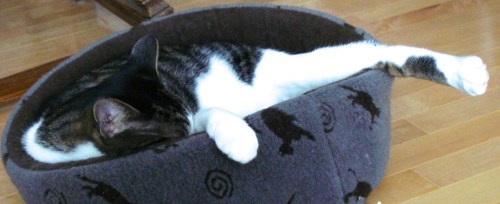
un chat passant parmi les livres,
et des amis en toute saison,
sans lesquels je ne peux pas vivre.
 rogermoorepoet