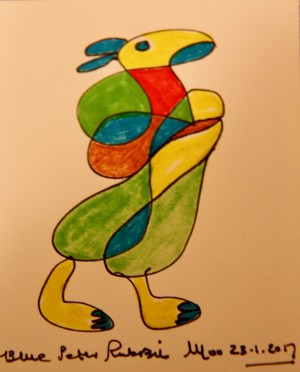
Surprise!
Whoa! Look at this!
What a surprise!
Sometimes you can’t
believe your eyes!
I heard a rattle
at the feeder,
thought it was
a deer,
saw this cheeky chappy
walking away.
Surprise!
Whoa! Look at this!
What a surprise!
Sometimes you can’t
believe your eyes!
I heard a rattle
at the feeder,
thought it was
a deer,
saw this cheeky chappy
walking away.

Driving at Night
Once upon a time,
my hair was brown and curly,
but now it’s straight
and as white
as this drifting snow
that clogs the windshield.
I smooth down my hair
with my fingers:
swollen knuckles,
crooked joints.
I burn with feverish thoughts
yet cold blood shivers
through my arteries.
Headlights
blind me in my good eye.
The other one’s useless
when I drive at night.
It’s a long time
since I last saw,
let alone touched,
my toes.
Putting on my socks
or tying my shoelace
is a morning no-no.
Short of breath,
of agility,
with no ability
to climb up stairs:
what happened
to my youth?
Where did
my childhood
go?

Christopher Columbus
Interviewed by Hieronymus Bosch
on His Return from the New World
“Winged creatures came with the dark,
their human faces cast in the features
of people I knew and loved.
Subtly transformed, they seemed reborn.
Their leathery wings
creaked like horse harness
and the “Splat!” of their excrement
was a slow drum beaten to a gibberish
march of dream after dream.
What could they portend?
My sister, nose stretched to beak;
my brother, lost at sea,
his eye teeth now enlarged
to a vampire’s fangs.
Each nightmare drew something
dark from my past, dressed it in fiendish garb,
and flew it with a guide-line:
a kite’s umbilical cord attached to the shadows
shifting above my bed.”

7:00 AM
Mass over, Tim stood, made a copycat sign of the cross, and walked out of the church. The boy with the cactus and the girl with her basket of flowers had left the courtyard. The witchdoctor, however, remained. He squatted on the ground, in a trance-like state. Before him, his fire burned low. The strong scent of copal rose from the coals, hung heavy on the air, then dissipated in curves and waves of thin smoke. Tim stopped for a second to look at El Brujo and, as he gazed, the witch doctor, without opening his eyes, spoke.
“It’s a wise man knows his own father.”
“What? What do you mean?” Tim’s knees shook and his voice became squeaky. It seemed to rise an octave as he mouthed dry words.
“I spoke to your mother yesterday.”
“That’s nonsense. My mother’s dead.”
“What ails you, my friend?”
Tim didn’t know what to say.
“If you won’t speak, I’ll speak for you,” El Brujo opened his eyes and stared at Tim. “One night, many years ago, Jaguar crept between your ribs and took your heart into his mouth. When he closed his jaws, your heart was as heavy as stone and Jaguar broke his tooth upon it. He cursed you and your heart remained a rock within your chest. At night, when you sleep, you dream of dust and ashes.”
“You speak in nursery rhymes and riddles,” Tim forced himself to remain calm yet the words fanned a sorrow within him that he had thought long dead.
“Perhaps, but do they speak true?”
Images flash through Tim’s mind.
… curses … stone … dust … ashes … broken heart … rock … heart in mouth … a marigold path … zopilote … high in the morning air … an old stone bridge … a river below it with the snow floating down to be carried away by the current … three crones dancing on the steps of an old stone building … three beautiful ladies dancing on the temple step at Monte Albán … an old man … dead … then alive and walking in his burial clothes … hummingbirds dancing round the sun … red slashes of blood … tulips against a white-washed wall … an old man vanishing into a tomb … the face of death simmering in the moon’s dwindling pool …
Tim shook his head from side to side.
“So, I see you have some knowledge,” El Brujo raised one eyebrow. “But do you trust that knowledge?”
“Tell me what’s happening, please.”
“What do you want to know?”
“I want to know everything.”
El Brujo turned down the corners of his mouth in a frown.
“Everything? Listen with care and remember. The rich man in Yanhuitlán bought a husband and wife from a nearby village for nine pieces of gold. Next day, he cut their throats at the foot of a large stone idol; then he sprinkled the dead man’s grave with their blood. When he did so, the rains returned, the crops grew again, and the sun continued on his daily journey.”
“That’s it?”
El Brujo nodded in assent.
“What has that got to do with me?” Tim’s voice quavered as he asked the question.
“You too must make a sacrifice, my friend, for in blood we were born, and in blood we will finish our days.”
“What kind of sacrifice? A blood sacrifice, like that boy?”
“No, not like that,” El Brujo shook his head. “You must sacrifice your beliefs and allow me to bless you.”
“I have no beliefs.”
“Even that is a belief.”
“Then I am sacrificing nothing.”
“If that is what you believe, it is so. Here: take this. It’s yours by right,” El Brujo held out his hand. A medallion on a braided leather thong lay in the palm.
Tim looked at the medallion and saw that it had been broken in two and that one half was missing. What remained showed a cross with a half bunch of roses where the crucified Christ would normally have appeared.
“This is your mother’s gift to you.”
“You’re crazy. You know that? I told you: my mother’s dead yet you still say my mother left me this.”
“I do and she did.”
“Did you know her?”
“I did.”
“I don’t believe you.”
“You may believe what you want. But tell me, do you not feel for the medallion? Does it not cry out to you?”
“I can’t say it cries out to me, but I like it, yes. How much do you want for it?” Tim put his hand in his pocket and drew out his change purse.
“You do not have enough money to purchase it,” El Brujo wrinkled his nose in distaste. “And if you did, you wouldn’t be the man I think you are and then I wouldn’t sell it to you. But it comes from your mother and it belongs to you. Here, take it and put your money away. Please, don’t insult me. Here, lower your head. I promised your mother I’d put this on you myself.”
Tim hesitated, but El Brujo’s eyes held a power that disconcerted him. He bent his knees and lowered his head and the copal that burned on the witch doctor’s fire made Tim’s eyes fill with water and blurred his vision. His lungs filled with its heady heaviness and El Brujo pushed him down towards the source of the incense. Tim inhaled and broke out in a sweat.
“You must wear this always. It will protect you,” El Brujo placed the medallion around Tim’s neck.
“But it’s broken.”
“Not broken, but divided. You must search until you find the missing half.”
“Did my mother tell you that?”
“Your mother is dead.”
El Brujo lapsed into silence and stared Tim down. After a moment, he broke into a weird, wailing chant, using a language that Tim had never heard before. As he sang, he brushed Tim’s eyes with an eagle feather that he drew from his shirt pocket.
“Now, you will be able to see.”
… an old woman dressed in black pushes a young man in the chest … woollen threads hang out their colors from her sewing basket … they flap like flags in a single ray of sunshine that breaks into a million tiny sparks of fire … hummingbirds, wing their dance around a sun that bears a dead man’s face … a pair of scissors snips at the string that ties the balloon to the earth and it floats away up into the air high above the cathedral tower … fire catches its wings and it flares like zopilote … the cathedral spire is a notched measuring stick conducting the clouds as they dance and weave their patterns … within the prison of the sky … trenchant shadows … twisted dancers … old warrior kings bend themselves into pipe wire shapes as they struggle to escape … an old man wrings his hands then vanishes … a soap bubble floats away on the wind … a young girl stands on a bridge in winter … snow swirls drawing a curtain around her falling body … an old crone wrapped in rags carries a bundle of clothes to a set of steps and leaves it there …
“The medallion vibrates, it’s heavy and warm.”
“It knows you.”
“What do you mean, ‘it knows me’?”
“Did you feel nothing? Did you see nothing?”
“I saw nothing,” Tim coughed and cleared his throat. “I saw nothing at all.”
“If you say so,” El Brujo stared at Tim long and hard. He opened his mouth to speak, then shrugged his shoulders.
“Come, you have accepted the medallion your mother left you. Now accept my blessing.”
Why?”
Because I ask you to. Are you such a coward that you cannot accept a blessing from a man old enough to be your father? Here, kneel beside me,” El Brujo tapped the ground at his side and Tim, wondering all the while what on earth he thought he was doing, knelt beside the witch doctor.
El Brujo leaned forward and blew on the fire. He added a handful of twigs and selected with great care three pieces of copal from one of his pockets. He thought for a moment then added two more pieces of incense. The fire caught and smoldering incense filled the air with its heady scent.
“This is a magic land,” El Brujo said as he sketched his spell onto the smoke rising from the fire and laid hands on Tim’s head, all the while muttering an incantation as he squeezed Tim’s neck between his thumb and forefinger. Tim didn’t struggle as El Brujo moved his head to where the incense was thickest. Tim coughed at first, then inhaled the incense and relaxed as his lungs filled with its aroma.
… the young man’s spirit drifts out of his body … it floats in the air above him … the witch doctor draws grief and sorrow from the young man’s heart … they circle for a moment … a sharp wind blows them away … a child’s balloon rises in the air … it soars upwards to where zopilote floats in the sky … the witch doctor chants and his words have the brightness of forgotten gods long-buried in splendour … still burning with life … he hangs a silver sun round the young man’s neck … it rests against his heart and mirrors the gold disc hanging from the sky … silver mingles with gold as the warm metals bond with flesh and blood …
Tim continued to inhale the incense and exuded thick beads of sweat as he struggled to remain conscious. El Brujo filled his heart and soul with honey and hibiscus. The witch doctor blessed him and again brushed his eyes with the eagle feather. Then he sat back, closed his own eyes, and waited for Tim to regain his senses. Tim’s eyelids fluttered; like a landed fish, he took in great gulps of air, then struggled to his feet, swaying for a moment and shaking his head. El Brujo remained motionless. Tim opened his mouth to speak, but could find no words. He shuffled away in silence.
… dry leaves gather in quiet corners where the morning breeze weaves them in endless figures of eight … a whirlwind of dead dust scuttles in mysterious circles … rats disturb old bones that lie drying on the floor of an age old attic in an abandoned house … a light brown hand rises for a moment … waves … then dips beneath icy waters …
Tim turned as he reached the edge of the square and looked back. The fire sputtered and one last spurt of smoke formed into a figure that crouched low beside the witch doctor and whispered in his ear.

Contract
The door to the Principal’s office opened just as Tammy approached, hurrying because she was late for class. Tom, her Department Head, stepped out and stood in her way.
“Tammy,” his tongue swiveled around his thin lips in nervous fashion. “I’m just talking with the Principal about your new contract. Come in,” he extended his arm and shepherded her towards the open door.
“Not now,” Tammy replied. “I’m late for class. “Can’t it wait?”
“Strike while the iron’s hot,” Tom showed teeth yellowed from tobacco. “We’ve got a great deal for you. Come in, come in.”
Tammy found herself face to face with the Principal.
“Tammy, my dear, we’re so proud of you,” the Principal flashed a row of crocodile teeth, two of them gold-capped. “I have some papers for you to sign.”
“But, I’m late for class and …”
“I know, don’t worry. This won’t take a moment,” Tom winked at her as he and the Principal led her towards a typewriter that sat on the desk with a blank page and two carbon copies inserted in it.
“Here, at the bottom of the page, just sign here,” Tom pointed.
“But it’s a blank page. I can’t sign a blank page,” Tammy stammered in response.
“You’ll see it when it’s typed and signed,” the Principal assured her. You can always change it later.”
“Can’t I come back after class?”
“I’m afraid not,” the Principal frowned. “I have an important meeting in half an hour, with the school board, and you’ll still be in class. This must be signed now if it’s to get board approval.”
“But you said … you said I’d only be here for a year …”
“We’re very pleased with you,” the Principal flashed the sunshine of his teeth. “We want to keep you here.”
“Very pleased,” said Tom. “This is a first class, independent school run, as you well know, on a non-profit basis. Only the children of the rich and privileged come here to study,” he paused. “And some of them come here because of you. That’s why I’m recommending you for this new and improved contract. I signed my first three-year contract this way, didn’t I?” he looked towards the Principal.
“You did indeed,” said the Principal. “And just look where you are now: Head of your Department.”
“A three-year contract …” Tammy blinked and ran her tongue over her lips. “I wasn’t expecting that. I thought a year … thank you … but …”
“No buts. Jobs are scarce nowadays, particularly in your field,” Tom looked at his watch. “Time’s getting on. You don’t want your students walking out of your class, do you? Here you are now: just sign here,” he handed her the pen he held in his hand.
“You’d better be quick,” the Principal said. “This offer may not be here tomorrow and … my goodness, look at the time. You are running late.”
“Sign,” Tom told her. “I signed and I never regretted it. Remember, we can always change the wording later.”
“Drop in after class,” the Principal smiled. “It will all be approved by then and you can read it and we’ll modify what you want.”
Tammy sighed and signed.
The Principal and the Department Head ushered her to the door.
“Hurry,” they exhorted. “Run. You don’t want to be late.”
Tammy ran to her class.
The two men watched her go. Then they went back into the office, shook hands, and grinned at each other.
Tammy never saw that contract. She stayed at the school for three more years, as she had promised, but in all that time she never got a pay raise and the not-for-profit school board never allowed her to join the employees’ health and pension plan.


Candles
I love the flicker of flame,
the yellow light dancing
shadows on face and plate.
Let’s clear away the dishes
and bring the table back
to its pristine state: grained
wood. Now let’s talk of old
times back home when coal
fires roared and drafts ran
from dark corners, raising
hair on necks and sending
shivers down spines. It’s so
easy to believe in ghosts
when night winds howl
through windows, dogs bark
at nothing, houses are older
than families, and the land
snuggles down to sleep
in its winter blankets.
Beware of the sudden draft
on the oil lamp’s frail chimney:
cold will crack the glass, sending
us to bed by candlelight while high
on corridor walls old folk come
alive and frown down from
their sepia photographs. Cold
and frightened by their restless
afterlives, we shiver in the grave
cloths of our damp beds.

In Vino Veritas
Last year, on the road to Pwll Ddu,
I turned the steering wheel too fast
and almost rolled the car I rented.
My mother’s ashes were in the back.
I was driving my father to the Gower
so he could scatter them on the sea,
as she had requested. “Watch what
you’re doing,” my father cried.
“You’ve knocked your mother down.”
Now, as I drink to forget her ashes
tumbling around in their plastic urn,
I call you names. Crude graffiti clings
to the wall I have built between us.
Can you forgive me? In vino veritas,
said the ancient Romans, but truth from
a bottle is a double-edged sword cutting
both striker and person struck. My love,
I sense stark darkness within you. I see
black stars exploding to flood blue skies
with their inevitable ink. Can you feel
the instant hurt behind my eyes, like I
sense yours? Here, in one of our secret
gardens, give me the pardon I never gave
my parents. Heal the harm I’ve done.
Forgive me. Break the cycle. Set us all free.
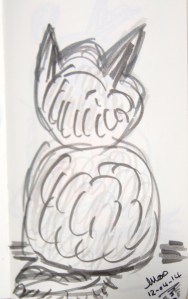
The cat …
The cat…
sits on the keyboard
swishing her tail …
how can my writing
ever fail?
The cat …
sits on the keyboard
nice and warm.
How can anyone
wish her harm.
The cat …
sometimes struggles
to understand:
a mouse on the table,
a bird in the hand …
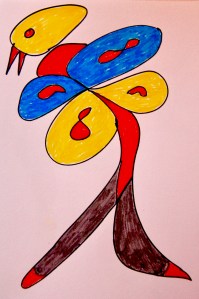
Wheelbarrows
Secret Garden #6
Once upon a time,
an inmate at Cefn Coed,
the Swansea lunatic asylum,
walked around the garden
with his wheelbarrow
upside down so nobody
could put anything in it.
Not so crazy, eh?
That’s what you and I are
without each other:
upside down wheelbarrows,
or wheelbarrows
with the one wheel missing,
or wheelbarrows
with the bottom boards gone
and everything falling out.
So here’s my card for you
on Valentine’s Day:
I’ve painted an upside-down
wheelbarrow missing a wheel.
There’s not a flower
or a heart in sight.
Anyone can give hearts
and flowers.
Only someone really special
merits a wheelbarrow,
upside down,
with the missing wheel
long gone.
 rogermoorepoet