Bistro 3 Flash Fiction

Blind Date

You couldn’t see the holes the doctor drilled in my head when he thought he was a woodpecker. You were oblivious to the bland, black splinters sprouting from my fingers and my neck. Unseen and unheard, the ladder-back drowsed its feathered siesta as peace descended to the cluttered attic of my mind. When push came to new love, the bluebird couldn’t find the old silver ring I borrowed from the curtains. How could you care about its failure to sparkle in the sun? When you ran your fingers through my hair, you cut yourself on a feather’s edge and my shirt rose up in the air and flapped with sudden writing, as red as blossoming flowers. You sensed their crimson dampness, but couldn’t see the petals turning skywards to a pallid moon. The clockwork mouse ran down the tower. The clock struck the chaos of a universe at sixes instead of sevens and we knew we two would never be one. You tapped with your white stick on the sidewalk, but before you drove away, you told me to keep my pity for falling leaves, for sparrows in winter, and for the defenseless chickadees who quest at the feeder and leave in fear of the kitchen cat with her dogged stealth: a game of paws and pause, crisp and silent through the green hair of the grass.

Winning not Whining!

Winning not Whining:
For Al

To be taken with a large pinch of salt.

Judgement by Committee:

IMG_0130

The committee gathers and sorts through the evidence: whatever will they find? Piece by piece, they sift the data. Some take it to great heights and drop it on the rocks to see how fragile it is. Will it break like a clam or a mussel released at the sea-side? Others use the Christmas Cracker technique. For this you need two judges: each holds an end, and both tug as hard as they can. When the evidence rips apart, then the opinion of the one with the larger segment of the manuscript holds good. They take care to avoid the cracker-jack bang in case the item is explosive, but more often than not it is good, solid fodder for thought, endless thought, and the longer they think, the more the liquids flow and more good food goes down, and the more their camaraderie strengthens. Finally, when all the energy is spent and the manuscripts are reduced to tiny shreds, a winner appears. If the last fragment of evidence is still large enough to be read, this is then showcased and the winner is announced. That is why those precious manuscripts are never returned and that’s why competitors should always send a copy, because the original, especially when dropped from a great height or caught by the explosion of cracker-jack, might be lost in the tidal wave of anguish that sweeps the sea-shore clean.

“What is the definition of a camel?”
“It’s a horse designed by a committee.”

Anonymous, or Aristotle, I don’t know who said it first; but it’s very true. And manuscript selection by committee can bring about some interesting selections. On several occasions I have received the damning note: “We really liked this: but one person on the committee said they didn’t like how you used this word …    (insert word in blank space after dots).”
Judgement by committee is judgement by consensus … and, as the TV game-show host so often repeats: “… And the survey says …”

There is only one way to deal with committee decisions in a writing competition: lots of laughter, a large pinch of salt, and water off a duck’s back.

Judgement by a single judge

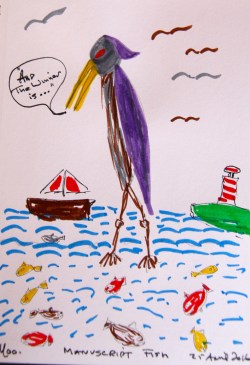
This is probably much better than judgement by a married judge who will always pick his partner’s work, if it has been submitted. With only one judge circumstances change and the chances of winning operate under different rules. Imagine that one judge as a Great Blue Heron standing in tidal water, beak poised, incoming tide, and the manuscripts swimming past. Some swim too fast, some too slow; some are too heavy and sink to the bottom; some are too light and float to the top. But look, the judge is tense, the perfect manuscript at the perfect depth glistens silver beneath the surface then … swift jab of the judge’s beak and we have a winner … and the judge holds it aloft to glisten in the sunlight while the losers swim happily away to survive as honorable mentions or silent witnesses that can be entered in another competition on another, perhaps happier day, when they can be judged by a committee of Great Blue Herons.
IMG_0131

It’s not always easy to be a good loser. However, as you swim freely away from the Great Blue Heron (GBH) remember you have avoided Grievous Bodily Harm (GBH) and that may be better than you think for: “It’s often good to not be a winner: you might end up as the judge’s dinner.”

And if you win? IMG_0130.JPG
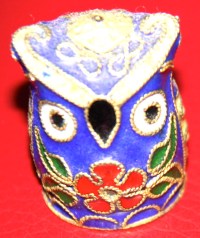
And if you win? Well, the judge (or the judges if you survived the survey), was very good, very intelligent, very hard-working, and just perfect; in fact, the very model of a wise old bird who knew just what it was looking for, and found it.

And as for the winner: “The winner, he was a wise old bird. The more he spoke, the less he heard. The less he spoke, the more he heard. There never was such a wise old bird.” (Anonymous or Aristotle)

Dreams

Dreams are important in Oaxacan mythology.

Do we create them ourselves?

Or do they come to us as celestial messages?

Can they exist without us?

Or do we form a symbiotic relationship.,
each dependent on the other?

IMG0023_1.jpg

Eight Deer or Tiger Claw / Ocho Venado or Garra de Tigre is a Mixtec Hero; 

his name is composed of two parts: 

(1) day name (ie the name of the day on which he was born) Eight Deer and 

(2) nickname Tiger Claw. 


His symbol in the códices is a small circle with a comma like a tiger claw.

Nuttall is the twentieth century editor of the Zouche Nuttall Codex 

in which Eight Deer’s history of conquest is recounted.

Nine Wind / Nueve Viento is another Mixtec Hero 

and the founding father of the race, according to some códices.

Dreams

Once I stole the nose from a sacred statue;
today I watch it cross the square attached to a face.
Eight Deer walks past with a fanfare of conches:
you can tell him by his donut with its little tail.

A shadow moves as zopilote wings his way across the square.
I caught him once on a midnight bus;
he begged me to fold his wings and let him sleep forever.

A gringa called Nuttall sells tins of watery soap.
Her children fill my days with enchantments:
bubbles born from a magic ring.

Eight Deer, eight years old, sets out on his conquests.
Nine Wind births his people from a flint,
or was it the magic tree in Apoala?

The voices in my head slip slowly into silence.
Sometimes I think they have no need of me,
these dreams that come at midnight,
and knock at my window.

IMG_0218.JPG

The Happy Hours

The Happy Hours

In my garden are many birds,
some with pretty looks.
Alas, so many of my birds
are never found in birding books.

Here’s the Oinky Boing-Boing Bird,
a veritable sign of spring.
When he appears, get out the spade:
it’s time for gardening.

His legs are yellow, his face is blue,
but he’ll bring good luck to you.

IMG_0169.jpg

When Mrs. Flowerhat comes along
the neighbors greet her with a song.
They cluster on branches in the tree
and chat together merrily.

No matter whether it’s rain or sun,
they tell tall tales about everyone.

IMG_0150.JPG

Occasionally, it looks like rain
and then the birds don’t fly.
They vanish or they hang around
with a tear drop in their eye.

IMG_0187.jpg

The sundial sleeps in the falling rain
and I find it really funny:
he only wants to tell the time
when the world is bright and sunny.

Horas non numero nisi serenas.
I count only the happy hours.

Tuesday’s Child

IMG_0220

Tuesday’s Child

Thursday’s Child has far to go …
so too does Tuesday’s child,
especially this one, when he sets out
on a Tuesday on a long journey.

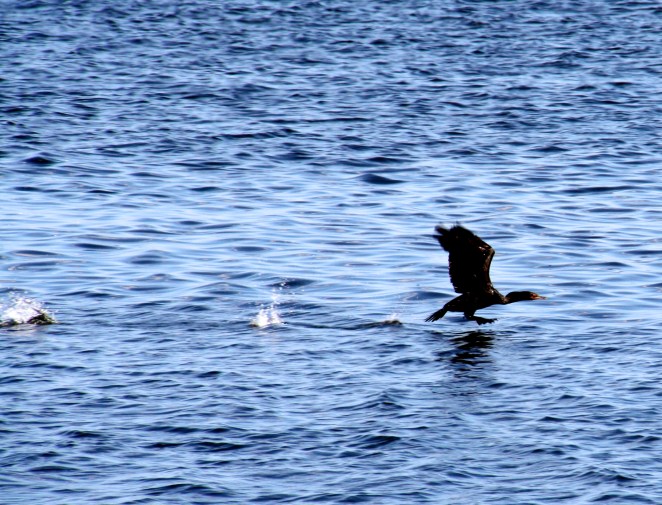
Just by chance, I caught this cormorant.
“Behind you, quick,” said Clare.
I turned and ‘Click!’

Such a miracle:
the first steps of flight
taken over water.
That first step heavy,
the second one lighter,
and the third one
scarcely a paint brush
pocking the waves.

The need for Tuesday’s Child
to take flight lies deep within me.
Fleeing from what?
Running towards what?
Who knows?

All I know is that the future
lies to the right of this photo
and the past lies to the left,
and I don’t know
what either might contain.

But I do remember the words
of Antonio Machado:

‘Caminante, no hay camino,
sólo hay estela sobre la mar.’
traveler, there is no road,
just a wake across life’s sea.

We may not know what lies ahead
but, like a ship at sea,
we leave white water behind us
and that wake tells us
where we have been
and what we have done.