People of the Mist 5

img_0146-2


7:00 AM

Mass over, Tim stood, made a copycat sign of the cross, and walked out of the church. The boy with the cactus and the girl with her basket of flowers had left the courtyard. The witchdoctor, however, remained. He squatted on the ground, in a trance-like state. Before him, his fire burned low. The strong scent of copal rose from the coals, hung heavy on the air, then dissipated in curves and waves of thin smoke. Tim stopped for a second to look at El Brujo and, as he gazed, the witch doctor, without opening his eyes, spoke.

“It’s a wise man knows his own father.”

“What? What do you mean?” Tim’s knees shook and his voice became squeaky. It seemed to rise an octave as he mouthed dry words.

“I spoke to your mother yesterday.”

“That’s nonsense. My mother’s dead.”

“What ails you, my friend?”

Tim didn’t know what to say.

“If you won’t speak, I’ll speak for you,” El Brujo opened his eyes and stared at Tim. “One night, many years ago, Jaguar crept between your ribs and took your heart into his mouth. When he closed his jaws, your heart was as heavy as stone and Jaguar broke his tooth upon it. He cursed you and your heart remained a rock within your chest. At night, when you sleep, you dream of dust and ashes.”

“You speak in nursery rhymes and riddles,” Tim forced himself to remain calm yet the words fanned a sorrow within him that he had thought long dead.

“Perhaps, but do they speak true?”

Images flash through Tim’s mind.

… curses … stone … dust … ashes … broken heart … rock … heart in moutha marigold path … zopilote … high in the morning air … an old stone bridge … a river below it with the snow floating down to be carried away by the current … three crones dancing on the steps of an old stone building … three beautiful ladies dancing on the temple step at Monte Albán … an old man … dead … then alive and walking in his burial clothes … hummingbirds dancing round the sun … red slashes of blood … tulips against a white-washed wall … an old man vanishing into a tomb … the face of death simmering in the moon’s dwindling pool …

Tim shook his head from side to side.

“So, I see you have some knowledge,” El Brujo raised one eyebrow. “But do you trust that knowledge?”

“Tell me what’s happening, please.”

“What do you want to know?”

“I want to know everything.”

El Brujo turned down the corners of his mouth in a frown.

“Everything? Listen with care and remember. The rich man in Yanhuitlán bought a husband and wife from a nearby village for nine pieces of gold. Next day, he cut their throats at the foot of a large stone idol; then he sprinkled the dead man’s grave with their blood. When he did so, the rains returned, the crops grew again, and the sun continued on his daily journey.”

“That’s it?”

El Brujo nodded in assent.

“What has that got to do with me?” Tim’s voice quavered as he asked the question.

“You too must make a sacrifice, my friend, for in blood we were born, and in blood we will finish our days.”

“What kind of sacrifice? A blood sacrifice, like that boy?”

“No, not like that,” El Brujo shook his head. “You must sacrifice your beliefs and allow me to bless you.”

“I have no beliefs.”

“Even that is a belief.”

“Then I am sacrificing nothing.”

“If that is what you believe, it is so. Here: take this. It’s yours by right,” El Brujo held out his hand. A medallion on a braided leather thong lay in the palm.

Tim looked at the medallion and saw that it had been broken in two and that one half was missing. What remained showed a cross with a half bunch of roses where the crucified Christ would normally have appeared.

“This is your mother’s gift to you.”

“You’re crazy. You know that? I told you: my mother’s dead yet you still say my mother left me this.”

“I do and she did.”

“Did you know her?”

“I did.”

“I don’t believe you.”

“You may believe what you want. But tell me, do you not feel for the medallion? Does it not cry out to you?”

“I can’t say it cries out to me, but I like it, yes. How much do you want for it?” Tim put his hand in his pocket and drew out his change purse.

“You do not have enough money to purchase it,” El Brujo wrinkled his nose in distaste.  “And if you did, you wouldn’t be the man I think you are and then I wouldn’t sell it to you. But it comes from your mother and it belongs to you. Here, take it and put your money away. Please, don’t insult me. Here, lower your head. I promised your mother I’d put this on you myself.”

Tim hesitated, but El Brujo’s eyes held a power that disconcerted him. He bent his knees and lowered his head and the copal that burned on the witch doctor’s fire made Tim’s eyes fill with water and blurred his vision. His lungs filled with its heady heaviness and El Brujo pushed him down towards the source of the incense. Tim inhaled and broke out in a sweat.

“You must wear this always. It will protect you,” El Brujo placed the medallion around Tim’s neck.

“But it’s broken.”

“Not broken, but divided. You must search until you find the missing half.”

“Did my mother tell you that?”

“Your mother is dead.”

El Brujo lapsed into silence and stared Tim down. After a moment, he broke into a weird, wailing chant, using a language that Tim had never heard before. As he sang, he brushed Tim’s eyes with an eagle feather that he drew from his shirt pocket.

“Now, you will be able to see.”

an old woman dressed in black pushes a young man in the chest … woollen threads hang out their colors from her sewing basket … they flap like flags in a single ray of sunshine that breaks into a million tiny sparks of fire … hummingbirds, wing their dance around a sun that bears a dead man’s  face … a pair of scissors snips at the string that ties the balloon to the earth and it floats away up into the air high above the cathedral tower … fire catches its wings and it flares like zopilote … the cathedral spire is a notched measuring stick conducting the clouds as they dance and weave their patterns … within the prison of the sky … trenchant shadows … twisted dancers … old warrior kings bend themselves into pipe wire shapes as they struggle to escape … an old man  wrings his hands then vanishes …  a soap bubble floats away on the wind … a young girl stands on a bridge in winter … snow swirls drawing a curtain around her falling body … an old crone wrapped in rags carries a bundle of clothes to a set of steps and leaves it there …

“The medallion vibrates, it’s heavy and warm.”

“It knows you.”

“What do you mean, ‘it knows me’?”

“Did you feel nothing? Did you see nothing?”

“I saw nothing,” Tim coughed and cleared his throat. “I saw nothing at all.”

“If you say so,” El Brujo stared at Tim long and hard. He opened his mouth to speak, then shrugged his shoulders.

“Come, you have accepted the medallion your mother left you. Now accept my blessing.”

Why?”

Because I ask you to. Are you such a coward that you cannot accept a blessing from a man old enough to be your father? Here, kneel beside me,” El Brujo tapped the ground at his side and Tim, wondering all the while what on earth he thought he was doing, knelt beside the witch doctor.

El Brujo leaned forward and blew on the fire. He added a handful of twigs and selected with great care three pieces of copal from one of his pockets.  He thought for a moment then added two more pieces of incense. The fire caught and smoldering incense filled the air with its heady scent.

“This is a magic land,” El Brujo said as he sketched his spell onto the smoke rising from the fire and laid hands on Tim’s head, all the while muttering an incantation as he squeezed Tim’s neck between his thumb and forefinger. Tim didn’t struggle as El Brujo moved his head to where the incense was thickest. Tim coughed at first, then inhaled the incense and relaxed as his lungs filled with its aroma.

… the young man’s spirit drifts out of his body … it floats in the air above him … the witch doctor draws grief and sorrow from the young man’s heart … they circle for a moment … a sharp wind blows them away …  a child’s balloon rises in the air … it soars upwards to where zopilote floats in the sky … the witch doctor chants and his words have the brightness of forgotten gods long-buried in splendour … still burning with life … he hangs a silver sun round the young man’s neck … it rests against his heart and mirrors the gold disc hanging from the sky … silver mingles with gold as the warm metals bond with flesh and blood …

Tim continued to inhale the incense and exuded thick beads of sweat as he struggled to remain conscious. El Brujo filled his heart and soul with honey and hibiscus. The witch doctor blessed him and again brushed his eyes with the eagle feather. Then he sat back, closed his own eyes, and waited for Tim to regain his senses. Tim’s eyelids fluttered; like a landed fish, he took in great gulps of air, then struggled to his feet, swaying for a moment and shaking his head. El Brujo remained motionless. Tim opened his mouth to speak, but could find no words. He shuffled away in silence.

…  dry leaves gather in quiet corners where the morning breeze weaves them in endless figures of eight … a whirlwind of dead dust scuttles in mysterious circles … rats disturb old bones that lie drying on the floor of an age old attic in an abandoned house … a light brown hand rises for a moment … waves … then dips beneath icy waters …

Tim turned as he reached the edge of the square and looked back. The fire sputtered and one last spurt of smoke formed into a figure that crouched low beside the witch doctor and whispered in his ear.

Writer’s Block: Wednesday Workshop

IMG_0182

Writer’s Block

Every day, well, almost every day, I meet people who tell me that they cannot write anymore. They have abandoned their current project. They sit in their work space and stare at blank screens or empty walls. They have come face to face with the dreaded Writer’s Block.

While some consider Writer’s Block to be an actual illness, others flaunt it like a flag or a badge of honor:

“Don’t touch me — I’ve got Writer’s Block: I wouldn’t want you to catch it.”

“I’m having a bad week: I’ve got Writer’s Block.”

“Sorry, I can’t make the writer’s meeting, I’ve got Writer’s Block.”

According to Wikipedia, “Writer’s block is a condition, primarily associated with writing, in which an author loses the ability to produce new work or experiences a creative slowdown. The condition ranges in difficulty from coming up with original ideas to being unable to produce a work for years. Throughout history, writer’s block has been a documented problem.”

We have probably all experienced the sensation of being unable to write, unable to think, unable to continue. As an academic, I found that something similar happens frequently in examinations with young students whose minds suddenly go blank when faced by a white page and an awkward question. This form of Writer’s Block comes at the most unfortunate times. Students need to be switched on just when their minds switch off. And something similar happens to writers.

Examination Block can be overcome. In many cases careful preparation for an exam will reduce or eliminate examination block. These preparations may well include correct note-taking and relevant revision procedures. There should be no last minute all-night study the night before the exam and a good night’s sleep, proper food, and water are essentials. Appropriate physical exercises before the exam starts are also useful as these make the heart beat and the blood flow. All these things prepare both body and mind and free the student for that most important task: the struggle with the blank page and the awkward question.

Will a similar set of preparations work for those who suffer from Writer’s Block?

In order to answer this question, I would rather take a different approach. Instead of seeing Writer’s Block as a physical / mental presence that stops us writing, why not look at it as an absence that can be overcome? What can we call that absence? Personally, I look upon it as an absence of creativity. If the creativity isn’t there, then writing creatively won’t happen. So what do we do?

Let us define creativity. For me, creativity is the expression of the creative principle that dwells within all of us. It is there, within us. We may suppress it or we may let it be suppressed. We may ignore it or we may deny it: but it is still there. It is always there. Sometimes it is beaten out of us; or we think it is. But it is still there, beneath the surface, waiting to be called on. The Roman poets spoke of it as Deus est in nobis … the god that dwells within us.

Creativity, for me, is like a river that vanishes underground and then reappears: it will be back.

The most important thing in my opinion is what you do when you’re not writing, what you do when you’re faced with that wall of blackness, what you do when you stare at that blank screen and nothing makes your fingers dance on the key board.

Here’s what I do. I make up my mind not to force myself to be creative. Forget about writing. Do something else. Ignore all idea of Writer’s Block, or the End of the World, or the Imminent Disaster of not being able to write. It may take a mental effort, but forget about it.

Now do something else, something positive. Different people respond to different stimuli. Here’s what I do.

(1) I read books
I read other people in their creative moments. I love reading people who write in other languages that I speak and read, because my own mind tries to recreate their images, their stories. This re-creation is a form of creation in itself. New words, new ideas, new combinations, rise to the surface of the mind, like bubbles on a river.

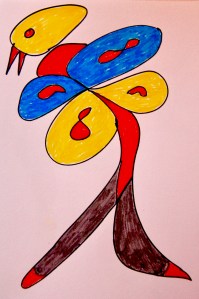
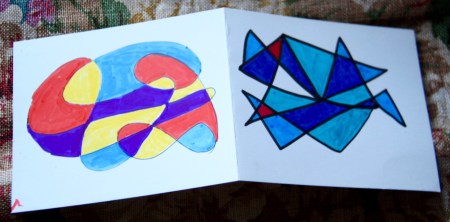
(2) I color and draw
As any who have seen my drawings know, I cannot draw. However, I can take a line for a walk. And that’s what I do. Then I color the spaces I create. My friends thought I was wasting my time and I believed them until I read one of Matisse’s sayings: “My ambition: to liberate color, to make it serve both as form and content.” Voilà: I have my raison d’être. Nature abhors a vacuum. When you create a space, color and meaning rush in.

(3) I take photos
The capturing of a moment: a sunset, a new bird at the feeder, deer wandering through the garden, a black bear visiting, rain on a spider web, sunlight through a prism, a cat made out of cherry stones … the re-creation of the moment is the creation of the memory. More bubbles flow on the surface of the stream.

(4) I go for a walk, look at nature and the world around me, people too
It is incredibly important to do this. A visit to the local coffee shop, a walk around the super-market or corner store, a seat in the park on a sunny day … just be yourself, believe in your existence, watch things as they happen, relax, look and listen, empty yourself, let the world flow back in … look at the ducks on the lake or the goldfish in the tank … more bubbles on the water, more ideas floating down the stream …

(5) I listen to music
De gustibus non disputandum … we can’t argue about taste. Where music goes, each person must make their own choices. The music I like fills my mind, relaxes me, flows out when it ends, takes my mind for a walk and leaves … a vacuum … into which dreams and colors, words and ideas, build like clouds …

(6) I cook
Cooking has always relaxed me. Sometimes the repeating of an old recipe helps clear my mind. Sometimes I have a need to invent something new. Hands and mind occupied, the secret, sacred underground river of creativity flows on …

(7) I sew
Last summer, an unexpected event led me to join a quilting group … oh what fun … a man quilting among a dozen women … I learned so many things … so many different ways of looking at the world … so many concepts that I would never have dreamed of on my own … Sewing runs in the family: I still have my grandfather’s sewing kit … darning and sewing needles that served him for two years before the mast … that darned his socks as he survived in the trenches of the First World War … it bears his name and I use it with pride … and what memories arise in my mind as I choose the needle … his needle … the one that will lead me into the next adventure, be it quilt, button or patch …

(8) I keep a journal
… and come hell or high water, I write in it every day and have done so since 1985. That’s 31 years during which I have scarcely missed a day. The writing maybe banal, it may be nothing but a note on the weather or a comment on a sporting event … but it’s there … a vital challenge to the idea that Writer’s Block can take me over and stop me writing. This journal is 95% drivel … maybe more … but bobbing along the stream of words are ideas, verses, rhyme schemes, choruses, stories, flashes of inspiration, jokes, memories, magic moments, falling stars, … the secret is to catch these falling stars, to recognize these rough diamonds and to return to them and polish when the moment is ripe … and it will be, sooner or later … for bubbles are buoyant and will lift you to the stars.

(9) Free Writing and the Creation of Metaphors
I also use the journal for free writing and automatic writing. These techniques, drawn from the Surrealists, allow the mind to wander at random. While wandering, the mind creates an interior monologue or a stream of consciousness that in fact turns up a series of delightful metaphors that can be polished and re-used at will. When I use this style of writing, I am reminded of Dalí’s saying (again and as always, from memory): “I don’t know what it means, but I know it means something.” My own theory of metaphor is that the metaphor is defined by two (sometimes more) points and rather than settling on one or the other (as in a simile), the mind moves and flickers sub-consciously between the two extremes so that meaning is sensed, but rarely can be grasped or stated in definitive terms. Thus, the marvelous line from André Breton, quoted by Mr. Cake,  “The wolves are clothed in mirrors of snow” has, according to my theory of metaphor, four defining points, namely, wolves … clothed … mirrors … snow. All four of these defining points creates an image, a very personal image, in the reader’s mind. The mind moves quickly between each defining point and meaning is lost in the rapid shift from image to image. Quite simply, “the hand cannot grasp it, nor the mind exceed it.” This means we have to return, as readers, to the unconscious level where the metaphors were first created. Then: “when we no longer seek it, it is with us.” This same analytical exercise can be performed for each line of Breton’s poem. When we indulge in free writing, much of what we write can be abandoned. The secret is to recognize and rescue the little gems we so often find.

(10) I believe
Through all this runs a thread of belief … belief that the black cloud of despair will not win. The Writer’s Block will go. Creativity will never be lost. It is there, beneath the surface, always ready to be contacted, waiting to rise and take you over again. And all too soon and quite unexpectedly, one form of creativity slips into another and the creative writing (it never really went away because of the journal) comes back.

Writer’s Block: it does exist. It’s how we deal with it that’s important. Creativity rules: forget Writer’s Block and let creativity and the multiple ways back to creativity grow and flow. Sooner or later the clouds will lift, the sun will return, the block will unblock and the words will flow again.

Remember the words on the Roman sundial: Horas non numero nisi serenasI count only the happy hours. And remember: the clouds will lift, the sun will return.

Trust me.
And believe.

Comment:
I first posted this entry on 17 August 2016. Since then it has received a number of hits and comments. Today, I have revised it and tightened it slightly, but the main ideas remain the same. I will try and continue with my Wednesday Workshops on a regular basis throughout 2017. Wish me luck.

Terza Rima

img_0188
Terza Rima
 Apologia pro verbum meum
Dear followers of my WordPress Blog: sometimes
I write what I do not mean to write
and say what I do not mean to say. Rhymes
make things clearer, for I puzzle what I might
say, and plan ahead so an awkward word
doesn’t intrude. Words, birds in flight,
bright as postage stamps across the absurd
white snow of a page or a digital screen:
when I think about it, I assume about a third
of what I say, I really mean. Who has seen
the early morning wind drifting our thought cloud
across trees and lawn, shadows cast on green
leaves of grass as we think our thoughts aloud,
each thought a pea in a pod, as some we clasp
between finger and thumb while others crowd,
and the loud, uneasy word slips from our grasp
to wound or injure or otherwise to hurt and maim.
It’s not my aim to do this. My word is not an asp
or a viper or a screw to be driven. I lay no claim
to hurt and yet sometimes a word slips sideways
and does not say what I mean it to say. I aim
to please, to tease, to provoke, in so many ways
and yet I often hurt where no hurt is intended.
If I have done you wrong and my word displays
unintended ends, forgive me: let all rifts be mended.
Comment:
Terza Rima was, for a long time, the chosen verse form for letters and epistles: the epistolary form, in fact. The rhyme scheme is very flexible and easy to maintain and the syllable count is also relatively easy. As for the length of the letter, well, that is entirely up to the writer. The one that I have chosen here has seven tercets and ends in a quatrain. The quatrain is a standard “stitch up” with which to end. I have used the epistolary form on many occasions, especially when sending postcards and letters to friends. Add it to your poetic arsenal. You will not regret doing so.

Wheelbarrows

img_0183-2

Wheelbarrows
Secret Garden #6

Once upon a time,
an inmate at Cefn Coed,
the Swansea lunatic asylum,
walked around the garden
with his wheelbarrow
upside down so nobody
could put anything in it.
Not so crazy, eh?

That’s what you and I are
without each other:
upside down wheelbarrows,
or wheelbarrows
with the one wheel missing,
or wheelbarrows
with the bottom boards gone
and everything falling out.

So here’s my card for you
on Valentine’s Day:
I’ve painted an upside-down
wheelbarrow missing a wheel.

There’s not a flower
or a heart in sight.
Anyone can give hearts
and flowers.
Only someone really special
merits a wheelbarrow,
upside down,
with the missing wheel
long gone.

Sancho Panza

img_0282

San Chopanza

 Men of La Mancha

“How much did you say?
Is it in writing?
Let me see the words.
Better, since I cannot read,
let me taste the gold.

You have not brought it?
Just this paper signifying cash?
And promises? Promises
I can trust because you’re known
to keep your word?

Thank God I cannot write.
I will not make my mark.
Men like you I met
when I governed my island,
and I chased them from my realm.

Owners of hollow staffs,
muscular women
strong in the arm and weak
in defense of their honor.
Do you, sir, take me for a fool?

When you awake the man,
beware the grown-up’s fist.
Do you know who I am?
Have you read my history
that tours the world in print?

 Read it, sir, and know me
for who and what I really am.
And the next time that we meet,
if you would drive a bargain,
bring gold, good food, and wine.”

Gifts: Wednesday Workshop

img_0177

Gifts
Wednesday Workshop
16 November 2016

Gifts or blessings? I am never sure which is which for many a gift is a blessing and many blessings are gifts and sometimes the ones come disguised as the others.

So here I am, in retirement from a career in teaching. I miss my students. I miss the hurry and scurry of the classroom, the deadlines for essays and exams, the highs and lows, the setting of goals, the solving of problems, the light at the end of the tunnel when, after four years, the students, armed with their degrees, set out to face the world, their world, their  brave new world fit for brave new students.

Nowadays, I feel like the lost man, the forgotten man. The deadlines have gone. There is no more rush and tumble. Peace rules the office in my house and dust and spider webs gather in the corners of my mind. I am reminded of the words of Francisco de Aldana: “lo mejor es estar muerto en la memoria del mundo” / best of all is to lie dead and forgotten in the memory of the world. Then I look around me and see the gifts.

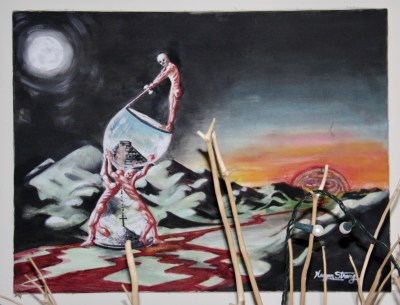
From Megan Strong:

IMG_0297.jpg

“Do I have to write an essay?” Megan asked me. “Couldn’t I do something else?”
“What would you like to do?”
“A painting. I’ll explain it in Spanish.”

And she did. There are no essays pinned to my walls, but this gift of a painting reminds me of something very precious: a student’s will to be creative, the presentation of knowledge in formats that are not necessarily the expected ones, the ability to be flexible, to understand, to open one’s eyes to the world around one, to see and encourage talent. These were the blessings, some of them anyway, that came with Megan’s gift and her ability to paint.

From Jane Tims:

IMG_0274.jpg

Clare and I visited Jane in her studio home. We drank tea and shared the afternoon sunshine together. Then, just before we left, Jane asked us to choose a painting. Clare chose this one: Apples. We went home and, after much thought, placed it on wall in our kitchen, just beside my chair. I see it everyday and so does Clare. It brings light and warmth to the room and reminds us of Jane’s gifts: her writing, her poetry, her research skills, her drawings, and her paintings. This one above all, for it is so meaningful to us and brings us light, peace, and stillness: such precious gifts.

From Jan Hull:

IMG_0279.jpg

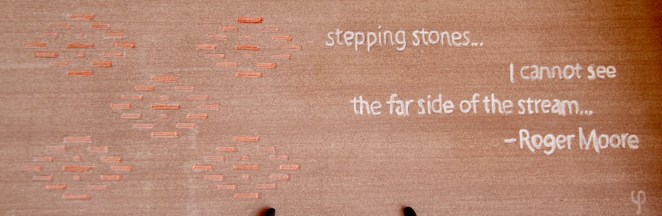
I cannot say enough about this stone sculpture gifted to me by Jan Hull in Shediac, New Brunswick, on November 4, 2016. Jan Stoneist has taken one of the motifs from my book Stepping Stones and has placed it on the left hand side of the carving. On the right hand side she has taken one of the verses from the book and added my name. The result is both a gift and a blessing. Jan searched carefully for the right surface on which to carve her offering and finally found it: Welsh Red Sandstone. What better gift for a poet from Wales … and indeed, Jan makes me feel truly blessed.

From Ainsley Swift:

IMG_0294.jpg

In the days immediately after my retirement, when I found myself at the bottom of the well, looking up at the daylight through a long, dark tunnel, Ainsley appeared at my door and asked me if I would be willing to mentor her as she was having some difficulty with certain aspects of her studies.  Brightness descended upon me and Ainsley and I have worked together for some time now. One day, she turned up with a brown paper parcel and announced that “This is for you.” I didn’t even know that she painted, let alone that she was a talented artist. Another gift, another blessing, light breaking where no light shone, and that brightness still surrounding me.

From Juanra Sánchez:

IMG_0290.jpg

What does one say about the man who persuades the retired stone-cutter in Avila to make one last carving in the style of the verracos that were carved by the Celt Iberians thousands of years ago? Here it is, my own verraco, gifted to me by the best of friends who, every Sunday for four consecutive summers, drove me around the Province of Avila and showed me the love he held for his land. Thanks to Juanra, I saw places and things, too many to enumerate,  that no tourist will ever see. A weighty gift indeed, and a true blessing that will last as long as granite bulls stand firm beneath wind, rain, and snow.

This verraco comes with a story. It is very heavy and very solid. I placed it in my carry-on bag and hoped that nobody would think to weight it. Tired of carrying it on my shoulder at the airport in Madrid, I stood in line, then placed the bag upon the ground. The line wasn’t moving, so I walked a few paces to the wall and leaned up against it. Lines shuffle and flex, as we all know, and that’s what happened. Gradually a small space opened up between my bag and the man in front of me. The man behind me was impatient to close that gap. He looked at me as I leaned against the wall. I half-closed my eyes and watched him. The line shuffled forward. He brought his leg back and gave my bag a mighty kick, right on the rear end of my granite bull. I can still see that man hopping on one leg, cursing, and my bag sitting there, having moved not an inch.

Gifts and blessings, along with kind words and actions, move the heart and soul. I will write more on this subject at another time. Meanwhile, remember the old song: if you can’t sleep, “count your blessings instead of sheep.” I just did and five of them are listed right here.

Bacchants

IMG_0157

Bacchants
after

Velásquez

Go down to Queen Street
on a summer evening,
or walk to Odell Park
and look in the dark
beneath the trees:

you’ll find them
gathered round a fire,
drinking meths or after-shave.

Fly Karsh from Ottawa.
Lodge him in the Beaverbrook
then bribe these Bacchants with free
booze and bring them to him.

One day their photos will hang
with those of Hatfield or Robichaud
in the New Brunswick Hall of Fame.

That’s what Velásquez did
when he painted his dwarfs
and topers, and you can see them
in the Prado today,
as famous as
Spain’s King and Queen.

Pilgrim

IMG0024_1.jpg

Pilgrim

Santiago de Compostela

She drew me out from inner darkness,
told me to rise and walk.
“But first,” she said, “your wounds.”

She washed them in laughter,
dried them with her smile.

I left that night
walking west beneath the stars
to where the red sun
dips beneath the horizon.
South I wended my way,
where winds are warmer.

Hope flowered anew each day.
Dew on the morning grass
gifted both food and water.
Birdsong raised its morning voice
to the creator and her creation.

Sunlight flooded my body.
It flowed out through my heart,
a beacon to light my way.

At night, when star song
brightened the owl’s path,
I saw my road
stretched high above me.

Pilgrim through once barren lands,
the light she lit for me
burns within me still.

 Rain, sleet, snow, ice, fire:
they’re all the same.
No lion shall me fright.
I’ll with a giant fight.

“Constant,” she said to me.
“Come wind, come weather.”

El Cristo de Carrizo

F1030024 2

El Cristo de Carrizo

For Tanya Cliff

“Contemplate this crucifixion.

Each time you sin
you plant a fresh
thorn in your savior’s
crown.

Each misdemeanor
spears the sacred side
or hammers a nail
in hand or foot.

Christ lives in you.
your daily misdeeds
nail him daily to the cross
he bears for you.

No death, for him,
no resurrection:
just an everlasting hanging
from these nails you daily drive.”

Cave Paintings: Altamira

IMG_0177 2.jpg

Cave Paintings
Altamira
(11,000 BCE)

Cold rock presses on shoulder and neck.
Sunshine dwindles until daylight is a distant star.
A great weight of earth weighs me down.

The tour guide strikes a crimson spark.
Firelight flickers, shadows dance, animals appear:
deer, elk, boar, buffalo.

Magic illusions
created from fat, charcoal, red ochre, ash …
how long have these huddled herds
grazed their way across these walls?

 My spirit sweats as elders anoint
my flesh with bear grease (for strength),
with greyhound hair (for speed),
with wolf blood (for tenacity on the trail).

They brush my eyes with eagle feathers.
Now I am a hunter.

I envision the animal my arrows will pierce.
My backbone arches like a bow.

 I shoot thought arrows:
my beloved dances her death dance on tip-toe.