
Lazy Day
Still worn out after last weekend. Sorry.
Here’s a link to follow.
You’ll know what I’ve been up to.
Lazy Day
Still worn out after last weekend. Sorry.
Here’s a link to follow.
You’ll know what I’ve been up to.

Teeth
Lunchtime.
Tiggy opens a can of tom8to soup and heats it on the stove. She slices the remains of yesterday’s loaf of bread into one inch cubes and fries them in olive oil and garlic. Tom8to soup with croutons. Then she puts two slices of bread in the toaster. Her father will only eat toast soaked in butter and layered with Marmite when he eats tomahto soup.
“Lunch is ready,” she calls out.
The black American Cocker Spaniel, bought by Tiggy’s late mother, in a moment of madness, by telephone, unseen, camps in the kitchen. It nests at the far end of the table, by the stove, and defends its territory with warning growls and a snapping of yellowed teeth. Tiggy will not go near the dog.
“Lunch is ready,” Tiggy calls out, a little bit louder. Dog, as they call him, growls and clatters its teeth. It has hidden a treasure in the folds of its old, gray comfort blanket, and guards it with the fierce, loving worry of a dragon protecting its golden hoard.
Tiggy’s father enters the kitchen as she places the soup on the table.
“I’m not ready to eat. Put it back in the pot.”
“What’s wrong, dad? I thought you were hungry.”
“My teeth,” he mumbles through a mouthful of pink gums. “I can’t find my teeth.”
“Where on earth did you put them?”
“I don’t know. If I knew where I’d put them, I wouldn’t have lost them.”
Tiggy’s father circulates round the kitchen opening drawers, lifting saucepan lids, and shaking empty yogurt pots to see if they’ll rattle.
“I can’t find them anywhere. I can’t eat lunch without my teeth.”
“But it’s only soup, dad, tom8to soup.”
“I don’t like tom8to soup. Your mother always made tomahto soup. Why can’t you be more like your mother?”
“Sorry, dad. I’ll call it tomahto soup, if that will make you feel better. But it’s still made out of tom8toes.”
“Don’t be so sarcastic. Help me find my teeth,” Tiggy’s father stomps towards the stove and Dog growls fiercely from its blanket as it guards its treasure.
“Take that, you dirty dog,” Tiggy’s father lashes out at Dog with his stick and cracks it across the head.
“Dad, stop that. It’s not Dog’s fault.”
Dog howls and spits out what it is chewing.
“There they are,” Tiggy’s father bends down, picks up his teeth, still hairy from the blanket and bubbly from Dog’s saliva. He pops his teeth into his mouth.
“That’s better,” he says, “now I can enjoy my lunch.”
Comment:
I included this short story, first published here on my blog on April 13, in Devil’s Kitchen, my new story collection that received third prize in the Writers’ Federation of New Brunswick David Adams Richards Award for prose this year. I will probably read this tonight, at the awards ceremony that follows the banquet here in Quispamsis. It’s a beautiful morning, with sunshine streaming through my bedroom window. Hopefully a full day of sun and warmth will help decrease the already diminishing flood waters that have struck this area of the Lower Saint John River Valley.

Friday Fiction
11 May 2018
Woof!
The old man limped up to the check-out in Chapters and placed a brown, hand-made, Italian notebook on the counter.
“Did you find everything you were looking for?” The check-out girl inquired.
“No.”
“Oh dear, what were you looking for?”
“My dog. I lost my dog.”
“Here? In the store? I can page security. I’m sure they’ll find it.”
“No, you mustn’t do that.”
“It’s no trouble. What color is it? Male or female? What breed? Large or small?”
“No, no. You’re much too kind. I lost him at home.”
“I lost my cat last week,” the check-out girl told him. “We searched everywhere for her.”
“I searched for my dog. All around the block. The dog usually comes home. This time he didn’t.”
“That doesn’t sound good. We never found our cat. My mom said the coyotes got her.”
“That’s not nice. We lost a cat.”
“To coyotes?”
“No. To mapaches, you know, to raccoons.”
“I miss my cat.”
“Me too. I also miss my dog.”
“I hope you find him.”
“I will. Oh, look. Here he is. Safe and sound.”
“I don’t see him,” the check-out girl looked around the store from her vantage point behind the cash register but didn’t see any dogs.
“His name’s Woof,” the old man pulled a small, fluffy, black-and-white dog out of his pocket and put him down on the counter. “Here, you have him. He’ll help make up for your lost cat.”
“I couldn’t possibly …”
“Don’t be silly.”
“No. Thank you very much. But I can’t take your dog. Here, put him back in your pocket. Oh, and that will be eight dollars exactly.”
The old man held out a five dollar bill, a toony, and a loony.
“Thank you,” the girl placed the money in the till and the little bell chimed happily. “Here’s your receipt.”
“Thank you,” the old man turned and limped away.
When he passed through the exit barrier, the alarm bell rang, but he took no notice. He walked rapidly to his car, close by in the wheelchair parking spot. He pressed the starter button, placed Woof on the passenger seat, and drove away before security arrived. As he drove, the old man extracted a brindle hound from his coat pocket and waved him proudly.
“Hello Woof,” he chuckled. “I want you to meet Winnie. Welcome to the family, Winnie. You’re free now.”
He put his hand in his other pocket and pulled out a fluffy Dalmatian, all white with black spots.
“And this is Pooh,” he announced. “Woof, Winnie, and Pooh: all broken out of prison. We’re one big happy family.”
He tooted the car horn and Woof, Winnie, and Pooh sat up straight on the front seat, wagged their tails, and woofed in time to the tooted horn.
Recycling
“You never know when you might need it,” my
grandfather said, finger-nails cracking red-
waxed parcel string. Bright sealing wax rained down
on the tablecloth, covering it with hard,
scarlet chips. Wax cracked, tight knots emerged.
One by one, my grandfather first loosened
them, then sought the string’s free end, following
it along its snaking way from knot to
knot. Like Theseus following his twine
through the labyrinth below the palace, my
grandfather mused, hesitated, followed
the clues given him by the knotter’s mind.
Set free from its parceled knots and lashings,
he looped the string around his fingers and
tied the twine into a tight bow that he
stowed away for future use. Reef knots, slip
knots, sheep-shanks, bowlines, bowlines-on-the-bight,
he showed me how to tie them all. He taught
me too how to never tie granny knots.
“Never cut string with a knife: untie knots,”
strict his advice. I follow it today.
Commentary:
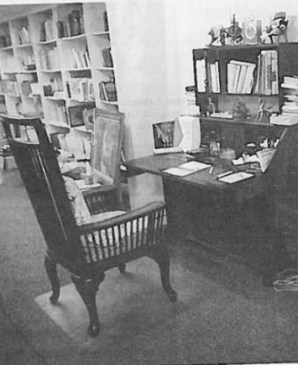
The photo shows my grandfather’s chair sitting before my basement desk where I write and store my books. I used to climb up the back of this chair when I was a tiny child, and blow on the bald spot on his head while he was asleep. Such memories nesting in the attic corner of the dormant mind. One day, I will write about that. Oh: I just did.

Darning Socks
(for Angela Wink)
My grandfather taught me how to darn socks.
I sat beside him by the fire and placed
a grey, wooden mushroom inside the sock,
stretching the sock wool to expose the hole.
He chose his colors with care, bright yellows,
oranges, reds, sky blues, anything that
stood out against the sock’s dark drabness. If
the socks were thin, he split new wool, pulling
it into individual strands that
he would draw through tongue and lips, wetting them
so they would thread with ease through the needle.
Curled wool threaded, I would cross-hatch the sock’s
hole, slowly forming a life raft that I’d
fill with colored wool. All my life, I have
darned socks, sewn buttons, mended my sweaters.
I always use bright colors, to my wife’s
dismay. Then, I know who did the darning,
and when. I still have my grandad’s First World
War sewing kit, all wrapped up in his signed
canvas wrap with his needles and some wool.
It’s lovely just to touch where his hands touched.
I still see dark blood traces where he pricked
his thumb, and where he sewed up wounded friends.
Commentary:
This poem comes from a comment, made by Angela Wink, on yesterday’s post. Such exchanges are precious and help create new memories. Thank you Angela.

Friday Fiction
04 May 2018
Crave More
Crave More: I hate those words. I always choose
a cart with the shop’s name on the handle.
I can handle that. I can’t stand a cart
that screams Crave More at me every time I
bend to place an item in the wire grid.
If stores were honest they would write Think More
and Crave Less on their shopping carts. I bet
that would cut into profits. Anyway,
there I was, in LaLaLand, leaning on
my cart, half asleep, when this ghost drifted
towards me. “Help me,” it said. “I’m hungry.
I need money for food.” I woke up from
my dream, looked at the ghost, tall, skeletal
thin, cavernous eyes and cheekbones sticking
out, gaps in the teeth, grey face drawn with shame.
“Sorry,” came automatically. Then I
too felt shame. I looked at him again. “I
only carry plastic.” The excuse limped
heavily across the air between us.
I saw something in his eyes, I knew not
what, and turned away. As I walked away,
I added one hundred pound of muscle
to the scarecrow frame. Took forty years off
his age. Filled his body with joy and pride,
not shame, and remembered how he played, hard
and fast, but true. I ran the card index
of former players that I had coached through
my mind. I knew their moves, and attributes,
the way they played the game, strengths, weaknesses …
I remembered him holding up the Cup.
But I couldn’t remember his name. I
pushed the cart all over the store in a
frantic search for him. At the ATM
I withdrew cash. I could hand it to him.
I could tell him he had dropped it. I went
through a thousand scenes. I could invite him
to the snack bar. I could tell him to buy
what he needed and follow me. Check out
time, I would add his purchases to my
bill. I looked everywhere. He was nowhere
to be seen. One opportunity. One
chance. That’s all we get. Miss it, and we blow
the game. Grasp it and we medal with gold.
Commentary:
I have been experimenting with iambic pentameter, counting words and syllables on my fingers, tapping rhythms on the table, driving Clare crazy, and disturbing the cat. I have also disturbed my usual way of writing, for better or for worse I am not yet sure. Yesterday’s entertainment was to rewrite my brief story, Crave More, as a poem in pseudo-iambic pentameter. The measures seem to function and the rhythm and word count move both within the line and in the melodic, rhythmic phrasings that move between lines in a constant enjambement.
So, by all means let me know what you think of this experiment. Here’s the link to the short story, also called Crave More. I would love to receive your opinions on narrative pseudo-iambic pentameter.
Revised Version:
Encounter
I was in the Superstore, leaning on
my cart, half asleep, when this ghost drifted
towards me. “Help me,” it said. “I’m hungry.
I need money for food.” I woke up from
my dream, looked at the ghost, tall, skeletal
thin, cavernous eyes and cheekbones sticking
out, gaps in the teeth, grey face drawn with shame.
“Sorry,” came automatically. Then I
too felt shame. I looked at him again. “I
only carry plastic.” The excuse limped
heavily across the air between us.
I saw something in his eyes, I knew not
what, and turned away. As I walked away,
I added one hundred pound of muscle
to the scarecrow frame. Took forty years off
his age. Filled his body with joy and pride,
not shame, and remembered how he played, hard
and fast, but true. I ran the card index
of former players that I had coached through
my mind. I knew their moves, and attributes,
the way they played the game, strengths, weaknesses …
I remembered him holding up the Cup.
But I couldn’t remember his name. I
pushed the cart all over the store in a
frantic search for him. At the ATM
I withdrew cash. I could hand it to him.
I could tell him he had dropped it. I went
through a thousand scenes. I could invite him
to the snack bar. I could tell him to buy
what he needed and follow me. Check out
time, I would add his purchases to my
bill. I looked everywhere. He was nowhere
to be seen. One opportunity. One
chance. That’s all we get. Miss it, and we blow
the game. Grasp it and we medal with gold.
Comment to the Revision:
The first eight lines of the original poem set the scene. While I tried to use them to accentuate commercial exploitation of the customer’s potential for greed, Crave More, they are not essential to the story of the encounter. Meg noticed this and following her interaction I have revised the poem, eliminating those first eight lines.
This is an interesting and inter-active way to work. Thank you Meg!

Wednesday Workshop
02 May 2018
The Poem Itself
One of the joys of downsizing one’s library is rediscovering old books, genuine treasures, that one wishes to read again. On my basement bookshelf I found an old copy of Stanley Burnshaw’s The Poem Itself (New York: Crowell, 1976). I thumbed quickly through it and found my old marginal notes on poems by Miguel de Unamuno and Antonio Machado. Reading the annotations to the poems I came across such literary and philosophical gems as these.
These brief insights into the nature of poetry sent me back to the book’s first pages and I read with much joy and pleasure the opening essay entitled The Three Revolutions of Modern Poetry (pp. xvii-xliv).
The first revolution is that of Syntax (p. xxiii). Word order is changed substantially and words and thoughts are inverted. Sixteen lines of Mallarmé (p. xxiv) are composed of one sentence with five commas and a colon. There is no logical sequence of beginning, middle, and end as one thing runs into another and thoughts shape-shift and move. The structure becomes that of presences and dreams as Mallarmé writes to his new theory: “to paint, not the thing, but the emotion it produces” (p. xxv). Other analyses of syntactical distortion and fragmentation follow and Emily Dickinson’s Further in summer than the birds— leads into Cummings’ my father moved through dooms of love / through names of am through haves of give. When I link this most modern movement to Francisco de Quevedo’s ‘soy un fue, y un será, y un es cansado’ / I am a “was” and a “will be” and a tired “is” … I realize yet again that all is not new in this modern world of ours. After all, Quevedo lived from 1580-1645, a modern poet indeed.
The second revolution is that of Prosody (p. xxvii). Rimbaud’s first poem in vers libre / free verse was written (probably in 1873) and published in 1886. Today, we are no longer shocked by the breaking down of the tyranny of verse. In fact, we are probably more shocked by people who use rhyming, metric poetry than by the many innovations in line length and word arrangement with which we are so steadily bombarded. That said, I still find some of Cumming’s innovations, Grasshopper / PPEGORHRASS for example (p.xxi) to be quite stunning and not always readily intelligible.
The third revolution is that of Referents, “the upheaval in poetic communication as a whole and specifically its referents” (p. xxxi). This is basically the writers of poetry turning to their private, interior worlds for inspiration. While poetry has always contained references to the self, modern poetry may be full of meaning for the writer, but that meaning doesn’t always extend to the reader. This is particularly true of automatic writing, surrealism, and the metaphoric poetry that floats, sometimes without factual substance, in the mind of reader and writer alike. Burnshaw isolates three moments in the development of this obscurity.
These three elements contribute to the privacy and hermetic obscurity prevalent in certain poets. Le jeu ne vaut pas la chandelle / the game isn’t worth the candle … alas, while some difficult poems and poets are very worthwhile, some poetry is definitely not worth the valuable time wasted in trying to decipher it. That is my conclusion: nobody else’s.
This re-adventure back into modern poetry contributed to a delightful voyage through the verse of Baudelaire, Mallarmé, Nerval, Verlaine, Machado, and Unamuno (among others). It is a voyage that I have started, but not yet finished. It is also a voyage that is generating new thoughts, fresh understanding, and a renewed desire to write. What more can a reader / writer desire than to be among friends, also sharing loneliness and despair and also held at bay by the living words of dead men, their voices and wisdom heard through ageing eyes that can still scan the printed page … vivo en conversación con los difuntos / y escucho con mis ojos a los Muertos // I live in conversation with the deceased / and listen with my eyes to the dead (in my friend Elias River’s translation) of Quevedo’s poem Retirado en la paz de estos desiertos.

Downsizing
a double sword
this clearing out
of odds and ends
the library diminishing
book by book
so many memories
slipped between the covers
dust-bound now
yet springing so quickly
back to life
sorrowful not sweet
these multiple partings
from people I will never see again
save in my dreams
I think of book burnings
so many heroes
going up in flames
fire their beginnings
fire their ends
fire the means of forging
the Omega and Alpha
of the book world
that surrounds us
fire encircling us
death’s bone fires
consuming us
outside and in

Dog Daze
the sad dog hounds me
sends me spinning
sets me back on my heels
makes me chase my tail
and snap at shadows
as they ghost
through my mind
memories deceive
desperate I lap
at licks of false hope
a shifting salt field
that increases my thirst
driving me on and on
deeper into ragged clouds
and the storm that lays waste
to the dog daze of my mind
Thursday Thoughts
19 April 2018
Cricket
Street cricket. Played on cracked tarmac. The wicket: three sticks whitewashed on to the high stone wall of our cul-de-sac street that backed on the railway yards. The wall the boundary. And the neighbor’s front yards. Six and out if you hooked and hit behind the wicket and over the railway wall. You also had to retrieve the ball yourself. Game stopped until you climbed the wall, looked down at the rail yards thirty feet below, and shouted until someone emerged from a workman’s hut to find the ball or throw it back.
No worker … no ball … no game. Then you had to run out of your street, down the main road, up the hill for two streets, beg permission at the locked rail yard iron gates: “Please, mister, can I go get my ball?” Then run all the way back down the railway lines to where the waiting players hung over your own street wall, shouting and cheering. Search for the ball among shiny rails, shunting rails, rusty rails, dandelions, thistles, and nettles, avoiding rolling stock and the occasional shunting engine. Find the ball. Try unsuccessfully to throw it back over the wall to the waiting hands. Try again. No good. Wall too high. Carry ball back to iron gates. Thank gate man politely so you can come back next time. Return ball to game. Game continues, rain or shine. Unless it’s real rain. The Lissingdowne / Pissingdown type. If so, run for nearest house and shelter by fire in kitchen.
Basic rules. Six and out if you hit it over the railway wall. Two runs and fetch the ball yourself if you hit it into the to bomb buildings at square leg, next to the railway wall. No fielders there. Banned territory. Still piled with grass-overgrown bombed bricks and debris. Fragile, crumbling walls still still liable to tumble. Cellars that might open up. Low walls that might collapse. Four and out in a neighbor’s front yard. Some were nice and didn’t mind. Watch out for the old witch with the garden gate. If you hit her window, even with a tennis ball, she’d be out quick as a flash, steal your ball, and wouldn’t give it back. Otherwise, it was single-batsmen. Run the runs and walk back from singles. One hand, one bounce. Tip and run once you’d scored twenty. One hand off the wall if you didn’t clear it for a six and out. Out if your fox terrier got the ball and ran round and round in circles with it in his mouth. Damn difficult to catch. Also his sharp, terrier teeth might puncture the ball. Damned dog. Lost ball and stopped match if the dog ran into the house and gave the ball to your gran who was saving it for tennis.
Cricket, in those days, was civilization. It had survived the bombing raids that missed the railway yards and bombed the bomb buildings. It had survived the machine-gun fire from the fighter-bombers that had strafed the street leaving bullet-holes, still un-repaired, in walls and shattering the glass of now-mended windows. It gave us a sense of rule and law, for the rules were strict and nobody broke them and stealing runs in tip and run was legal and not a crime.
Cricket: a small, bright window on the back-street where I lived, a window filled with happiness and light, even when it’s over the wall and six and out, or the dog runs away with the tennis ball, or the ball vanishes down a mysterious rabbit-hole in the bomb buildings and slides down to someone’s ruined cellar.
Game’s over. The Tests Match is on. The one primitive, tiny black-and-white screen in the street lights up with flickering figures and we sit around on the floor watching real men playing the real game on a grassy field in a fairy-book world, a world that most of us back-street boys and girls will never know or see, but that comes over to us as a dream of reality on this old black-and-white tv.
 rogermoorepoet