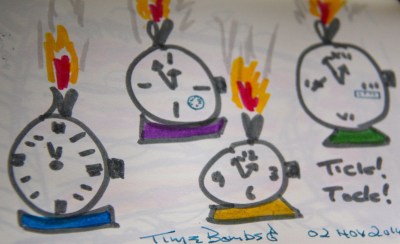
Purple
I close my eyes and return to Paris, Easter holidays, 1961. Algérie-française, Algérie-algérienne, the car horns tweet in the street as we drive the boulevards of a city divided. This is all new to me, a seventeen year old student in Paris to learn about French culture. My friends in the car have heard the tooting before and join in the fun. Algérie-française the driver toots.
Turning a corner, flattened and blackened, still flaming against a fire-burned tree, the metal skeleton of a Deux Chevaux, a ‘tin of sardines’, bears witness to the car bomb that has laid its occupants low.
* * *
Hitching the highway, from Paris to Chartres, thumb stuck out to catch the wind, a purple Citroen stopped and offered me a lift. I trusted the car: a Citroen, like Simonet’s famous detective Maigret used to drive.
When the car stopped and the door opened, I got in and saw that the driver wore black leather gloves. His hand movements on the steering wheel were stiff and clumsy and he made exaggerated gestures when he changed gear.
“No hands,” he explained. “Lost them in Algeria. Listen: I used to be the driver for a top General. I drove him out of an ambush once. I lost my hands later, when the car exploded, caught in a crossfire. They teach you things in the Army. I can still drive.”
He accelerated and threw the car at four times the speed limit through the S bend that snaked through a small group of houses. I bounced from side to side, held back by no seat belt.
“You see,” he said. “They train you to do this before they let you drive. Ambush. The sniper at the corner. The Molotov Cocktail. You must always be prepared.”
I closed my eyes and returned to Paris.
Collateral damage: the young girl with her photo in the Figaro next day, scarred for life; her mother, legs blown off, lying in the gutter in a pool of purple blood.
“Maman, maman,” the young girl cried. But her mother was never going to reply.
The Pom-pom-pompiers arrived in their fire trucks, sirens screaming. The ambulances screeched to a halt. The young girl cried. The mother bled out her life-blood in silence. Her blood turned purple and black as it flowed through the gutter.
Parisians emerged from dark doorways and stood there, bearing silent witness. Evening draped itself over the Paris skyline. The sky darkened and became one with the purple of the car bomb’s angry flame. Purple bruises marked my arm where I had gripped myself with my own fingers. An indigo angel squatted above the faubourg street, with shadowed wings, brooding.
* * *
I opened my eyes.
We left the village in our wake, travelling five times faster than the speed limit.
“They trained me for this,” the driver said. “I am prepared for anything.”
He stopped the car by the cathedral in Chartres. I thanked him and got out. He offered me his hand and I shook it. Inside the glove, the hand was hard and metallic. Alcohol sweated out through the purple veins that stained his nose and flowed in abundance over his sun-tanned face.
 rogermoorepoet
Those words, “collateral damage”. The history of humans is appalling. Evocative writing, Roger!
LikeLiked by 3 people
Thanks, Tanya. We invent such disguising language. Sometimes, as poets, we must invent a new language and open the world to new understandings. And no, it isn’t easy.
LikeLiked by 1 person
I feel blessed to live in Canada.
LikeLiked by 3 people
Most of our purple is Purple Loose Strife. was looking at your paintings today: so much beauty.
LikeLiked by 2 people
Thanks Roger. My next Isaac’s Way painting is in front of me. The theme is (you guessed it) space!
LikeLiked by 3 people
Space and spaces … your best work opens up both, to reader and viewer.
LikeLiked by 1 person
Intresting tale.dear moor.
LikeLiked by 3 people
The long history of France’s relationships with its colonies. Not always easy to understand the diverse and contradictory emotions.
LikeLike
True.dear roger!!
LikeLiked by 1 person
The more I read about colonialism, the less I understand it. Culture can be very difficult too: why this and not that?
LikeLiked by 1 person
Dear roger moor!!dt time was of colonialism n so much difficult era for human.bt culture is still now in its own shape and having some liberal attitude.before dis nobody knew and wanted to accept d specialities of other culture.i think-colonism had hurted very much to humanity bt a little bit profit was only for people for knowledge of others cultures.by knowing dis,intellectual peoples made liberal climate of world.
LikeLiked by 1 person
Very interesting comment. “The hidden path along which just a few wise men have walked” (Fray Luis de Leon). Cultures to share … not to conquer!
LikeLike
Yeah.dear roger moor!!Cultures to share…not to conquer.all historical facts tell dis thing.i have reached on dis conclusion by reading d history .u know-i m lect.in history.i think-u would be a lect.or prof. in history or poltical science.by comments on ur post,i have known ur dis aspect of ur life.is it right,dear?plz reply.
LikeLiked by 1 person
Professor … but retired … Spanish Literature plus Bibliography and Methods of Research.
LikeLike
Wonderful job ,dear roger!!dis job can be an inspiration for people.-
LikeLiked by 1 person
I very much enjoyed my teaching career.
LikeLike
Me too bt not like u because u have more qualification than me.
LikeLiked by 1 person
Qualifications are not everything, especially where good teaching is concerned. They do help in terms of getting a job, though!
LikeLike
But with this’-a combination of imagination is useful to create the beautiful feelings in d world.yes or not?dear roger.!!
LikeLiked by 1 person
I believe you are right. Imagination + Creativity + Beauty = Better World … I hope.
LikeLike
You are absolutely right ,dear roger moor.plz if u do’nt mind if i ask you to read my yesterday post.is it written in right way by me?plz reply. (Nectar or poison)
LikeLiked by 1 person
My e-mail is roger.moore@rogers.com Send me an e-mail and I’ll mail you a reply.
LikeLike
I have sent an e-mail just now.
LikeLiked by 1 person
Thank you. Reply will soon follow!
LikeLike
Good quote of Fray Luis de Leon.
LikeLiked by 1 person
He is a very fine poet (16thC Spain). Has elements of mysticism and is a strong Neo-Platonic. I really like his original works.
LikeLike
Thanks for giving more knoledge about Fray Luis de Leon,dear roger.
LikeLiked by 1 person
His poetry is very structured and rhythmic, hence difficult to translate. I know very few good translations of his works, if any.
LikeLike
I will do to try ,sure,dear moor!!
LikeLiked by 1 person