Sun and Moon 7

img0137_1

Sun and Moon 7

Old Woman weaves a crinoline from stars
she plucks roses from the void and turns them into haloes
nochebuena blossoms on the perfume of her breath

the cardinal’s song is a crimson voice hidden among leaves
mercurial in the moonlight
Old Woman coils her relentless cage

one by one the cardinal’s tunes are imprisoned
a butterfly impaled on a moonbeam
the last note of his song


Sun and Moon 6

img0137_1


Sun and Moon 6

“Wake up!” says Serpent. “Knock!
I knock and the door swings open

Old Woman sits spinning at a ghostly wheel
she draws me to her with a string of starlight
I squirm on the fishhook of her eyes
when I blink I fall gutted to the ground

herringbones knit me a tangled destiny
lost people wandering in a tapestry of dreams

as I read my story in the sky around me
Moon scythes my heart into tiny slices
a fishbone slides stitches into my side

dice click
two snake eyes stare into my eyes


Sun and Moon 5

IMG0023_1


Sun and Moon 5

dusky shawl of a knitted dream
wrapped round my shoulders
I pick at knots of tangled memory

a word as sharp as a stone
cast at a friend
sea shells cutting
naked feet
at the water’s edge
sunlight
weeping blood
over mother-of-pearl

Old Woman winds
a ball of wool
she handcuffs my wrists
with softness
spun from lambs
my hair turns silver in her mirror

snakelike I slide into my dream
slipping sideways
deep dark well of night


Sun and Moon 4

IMG0023_1

Sun and Moon 4

night without moon without stars
dark sand dropping
filling my mouth
I walk the lonely bed of a dried up river

when I stumble in my dream
my feet leave no footprints
colourless is my path
through shadow and sand

figures of darkness
conjured before me
hollow their eyes
their mouths black caverns
no flesh decks their bones

footless they sigh
a sibilant song
mindless they draw in
a net full of sorrows

silver fish darkling
losing their sparkle


Sun and Moon 3


IMG0023_1


Sun and Moon 3

at midnight Serpent slithers through
a gap in the fence of my dream
he slides close to my shivering body
and lies there chill against my skin

his length – a sword without a scabbard
unscaleable wall of unblemished steel
severing all warmth

“Tomorrow,” he says, “I will take you to the sky.
But first, you must watch me dance.”

he twists in circles winding and unwinding
infinite loops and figures of eight
endless cat’s cradle of bottomless shape

sleep draws my feet deeper into quicksand
the night wind whispers me a head full of dreams


Sun and Moon 1

IMG0023_1


Sun and Moon 1

Last week an old man squeezed the moon;
tonight, she’s a shrunken orange in the sky.

“Tell me, Moon:
when all the stars have been caught in my net,
what will I harvest?”

Silence descends a ladder of moonlight
bearing an offering of gift-wrapped stars.

“Wise Old Woman who lives in the sky:
what man tore your bones apart
and gave me your face?”

Dead leaves rush out through my eyes.
My hands stretch out before my face
and I wash them in moonlight.

“One day, I’ll climb to your silver palace
and steal all your secrets.”

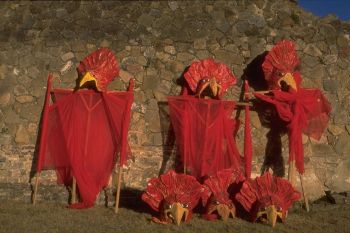
Comment: Sun and Moon 2 (as sung by Cat Leblanc) is introduced and complemented by Sun and Moon 1. These are the first two poems in the ten poem title sequence of Sun and Moon. The eagle costumes, shown in the photo, belong to the original dance sequence from Sun and Moon as performed on Monte Albán.

Sun and Moon

Sun and Moon

My poetry put to music: a new venture for me. This is Cat Leblanc’s version of Sun and Moon. I’ll add the words later. In the meantime: thank you so much for this Cat. Beautiful voice, beautiful music: a Fredericton, New Brunswick singer who is well worth following.

https://soundcloud.com/catleblanc/sun-and-moon

Alebrijes or Inspiration

alebrije2

 Alebrijes or Inspiration

 Are they half-grasped dreams
that wake, wide eyed, to a new day’s sun?

Or are they alive and thriving
when they fall from the tree?

Does the carver fish their color and shape
from his own interior sea?

Or does he watch and wait for the spirit
to emerge from its wooden cocoon
to be reborn in a fiery block of color?

Daybreak:
in a secluded corner of my waking mind,
my neighbor’s dog greets the dawn:
sparks of bright color born from his barks.

My waking dream:
dark angels with butterfly bodies,
their inverted wings spread over my head
keeping me comforted.

In the town square, the  artist
plucks dreams from my head
and paints them on carved wood.

Comment:   Alebrijes step out from dried wood and stand in the shower of paint that falls from the brush’s tip. Yellow flash of lightning, pointillistic rain, garish colors that mirror those of the códices. The carvings take the form of fantasy figures, anthropomorphic animals,
 and mythological creatures.

Sometimes one individual selects the wood, carves it, then covers it in paint. Occasionally an entire family takes part in the work of making the alebrije. One person collects the wood and prepares it for carving. Another carves and sands it. A third works on the undercoat, and a fourth applies the final patterns of paint.

The great debate: does the form in the wood 
reveal itself to the carver
 or do the carvers impose their own visions on the wood? In the case of the team, do the family members debate and come to a joint conclusion?

These thoughts, exchanged with wood-carvers in Oaxaca, have led to a series of interesting conversations. What exactly is creativity? Where does it come from? Do we, as artists, impose it upon our creations? Or do we merely observe and watch as new ideas float to the surface of our minds? How does the creative mind function? And, by extension, how much of the sub-conscious creative sequence can be placed into words?

These questions lead us into our own minds. How do we, as writers, frame our inspiration? Do we wait for the muse to descend? And what if she or he (for there are masculine muses, too) doesn’t? Does this waiting for the muse lead us into the dreaded realm of Writer’s Block where we sit and twiddle our thumbs and wait and hope? Or does it lead us into the land of positive expectations where we use basic writing exercises and look for inspiration among our thoughts and words?

A practical solution for inspiration is regular writing in the journal … regular writing. From this practice, we soon learn to recognize beauty for we often generate small gems that can be dug out and polished. Sure, there is a great deal of dross, but a good wood carving leaves lots of shavings, and a few cut thumbs. That’s the nature of artistic discovery … and remember, it is the beauty in ourselves and the world around us that we are seeing and describing. Reading the words of others also generates small sparks to which we respond and the corresponding interplay of ‘their words with ours’ is not to be under-estimated.

By extension, the Bakhtinian Chronotopos is also important: man’s dialog with his time and place. Bahktin uses the masculine ‘man’; a woman’s dialog may well differ, but her dialog with her time and her place is equally as important as a man’s. Sometimes more so, and we do not pay sufficient attention to this fact. That said, we must always remember St. Teresa of Avila’s delightful line: “También anda Dios en la cocina entre las pucheras” / God also walks in the kitchen among the pots and pans.

One of our tasks, as writers, is to find the beauty of our time and place. It may seem insignificant at first for we are such tiny beings in an enormous and often anonymous universe, but when we sit in the sunshine and see the dust motes rise and count the angels dancing in the sunbeams before our eyes, we are indeed witnessing the daily beauty that surrounds us. It is our task to name that beauty and to describe it. And remember, too, that it is there in the flying snowflakes, in the pale disc of the sun peering through clouds, in the slide of the raindrop down the window pane.

My job as a writer, as I see and feel it, is to sense and see the beauty that surrounds me. Then my task is to describe it and bear witness to it. To bear witness … sometimes, that beauty is brutal and the bearing witness is painful in itself. The knife or chisel slips, the blood flows, and the musty cobwebs applied to the open wound seem to do no staunching. But there is beauty in injury too and we must also bear witness to the brutal beauty of blood.

Such brutal beauty can be found in Tanya Cliff’s latest book, A Haiku for Ricky Baker. In this volume of poetry, Tanya exposes some of the problems inherent in child abuse.  Her inspiration is taken from real events and her poems describe the lives of real people. This poetry reveals the color of blood and hurts with the deep slice of the knife into the carver’s thumb. Tanya has two main tasks: the first is to bear witness and the second is to gather funds by offering the proceeds from this collection to the very children who need help. I wish her all the best in her endeavor and I encourage all my readers to explore this project of Tanya’s for themselves.

Water 2

15 May 2002 Pre-Rimouski 277

Rain Stick

The bruja turns her rain stick upside down.
Rain drops patter one by one,
then fall , faster and faster
until her bamboo sky
fills with the welcome
sound of rushing water.

An autumnal whirl of sun-dried cactus
beats against its wooden prison walls.

As I look heavenwards,
clouds gather,
rain falls in a wisdom of pearls,
cast from dark skies.

The scales fall from my eyes
and land on the marimbas,
dry beneath the arches
where wild music sounds,
half-tame rhythms,
sympathetic music
like this rainstorm
released by the bruja’s
magic hand.

(bruja: witch, witch doctor)

Comment: Every afternoon, in the rainy season, as regular as clockwork, the clouds build up and by five o’clock, the rain comes tumbling down. Nothing can describe the welcome smell of cool rain on dry dust and hot sand, the sound of raindrops pittering through the trees to splash on dry leaves, or the hiss of water on hot cobbles.

When the rain doesn’t come, then the Oaxacans who believe in the ancient traditions resort to sympathetic magic. They ask the brujos for help and the witch doctors bring out their rain sticks. Sympathetic magic: the sound of the sun-dried  cactus thorns falling through the hollow rain stick imitates the sound of the rain falling on the rain forest leaves. The clouds gather in sympathy and, sooner or later, the skies fill up with clouds, and down comes the rain.


Water 1

15 May 2002 Pre-Rimouski 277

Water

Water seeks its final solution as it slips from cupped hands.
Does it remember when the earth was without form
and darkness was upon the face of the deep?

The waters under heaven were gathered into one place
and the firmament appeared.
Light was divided from darkness
and with the beginning of light came The Word,
and words, and the world …

… the world of water in which I was carried
until the waters broke
and the life sustaining substance drained away
throwing me from dark to light.

The valley’s parched throat longs for water,
born free, yet everywhere imprisoned:
in chains, in bottles, in tins, in jars, in frozen cubes,
its captive essence staring out with grief filled eyes.

A young boy on a tricycle bears a dozen prison cells,
each with forty captives: forty fresh clean litres of water.
“¡Peragua!” he calls. “¡Super Agua!”

He holds out his hand for money
and invites me to pay a ransom,
to set these prisoners free.

Real water yearns to be released,
to be set free from its captivity,
to trickle out of the corner of your mouth,
to drip from your chin,
to seek sanctuary in the ground.

Real water slips through your hair
and leaves you squeaky clean.
It is a mirage of palm trees upon burning sand.

It is the hot sun dragging its blood red tongue across the sky
and panting for water like a great big thirsty dog.

Comment: Water: such a precious commodity, and more than a commodity, the very substance of life. Without it, we shrivel and die. Vegetation struggles to survive, the desert shifts its boundaries outwards, and a high tide of sand rises to engulf the cultivated land.

In Oaxaca, Mexico, the Atoyac, the Green River, often runs dry. When it does, women kneel on the sand and pebbles to dig holes into which the water seeps. They wait for the holes to fill and use little cups to pour that water into their buckets. These water holes are also used to wash their clothes and they hang them out on the riverbank bushes to dry beneath a burning sun.

Twice I have been in Oaxaca when the rains have not arrived. I have seen the reservoirs sink lower and lower as the sun laps up the precious liquid and no rain falls. Oaxaca, with or without rain, is a land of dry toilets, chemical toilets, chemicals to put in the tap water when you wash and peel fruit and vegetables. You drink only bottled water. It is sold to the households in forty litre bottles and hawked round the street by boys on tricycles who cry out their wares.

In Oaxaca, almost every house has its own supply of water. The flat roof, azotea, catches the rain when it falls and channels it into large internal cisternas that trap the water and keep it cool.  Water to waste is a luxury that few can afford and most water is recycled when possible in one way or another.

The rules are strict: drink nothing direct from the tap; do not clean your teeth in tap water;  beware of ice cream and ice cubes; drink only water delivered from trusted hands. In addition: eat food only from establishments with running water and a reputation for safety. Avoid street vendors, especially the little ladies in the street who cook over open fires and and change their babies’ nappies only to return to their cooking with unwashed hands … There are so many things you learn if you want to be safe and streetwise. Above all, close your nose to the delights of those wonderful street side cooking smells.