Scour the news for an entirely uninteresting story. Consider how it connects to your life. Write about that.

Daily writing prompt
Scour the news for an entirely uninteresting story. Consider how it connects to your life. Write about that.

Scour the news for an entirely uninteresting story. Consider how it connects to your life. Write about that.

Scour the news – what on earth does that mean? Let’s begin with scour – If you scour something such as a place or a book, you make a thorough search of it to try to find what you are looking for. Rescue crews had scoured an area of 30 square miles. Synonyms: search, hunt, comb, ransack. Search, hunt, scour, ransack – well? Which one are you after? And how long have I got? Question: what am I looking for? Answer: an entirely uninteresting story. What a tremendous waste of my time. And, when you get to my age, time is precious.

As for the news, well, what on earth do you mean by that? I speak several languages fluently. Am I looking for an entirely uninteresting piece of news in all of them? As one of the Two Ronnies used to say “You’re having me on, aren’t you? You’re having me on.” Let’s just stick to one language – English. Then let us ponder for a moment the meaning of the news. How many newspapers do you wish me to purchase and peruse? I am not a millionaire, you know. Or do you want me to listen to the news on the radio or the television? If so, how many channels? How about sending me online? I love the thought of that. There are thousands of websites out there filled with all kinds of news, good bad, indifferent, fake, artificial? And you want me to scour them all in search of, and I quote “an entirely uninteresting story”! Pull the other one, as the old comedians used to say, ‘”it’s got bells on”.

I’ll tell you what I’ll do. I’ll scour your prompt, that’s what I’ll do. Having given it a brief analysis, I declare it entirely uninteresting. Next I’ll consider how it links to my life. Well, sorry, it doesn’t. If I were to follow it through, I’d be sitting here for hours, wearing my fingers out on the keyboard. So, what’s the link between your prompt and my life? A total waste of time, that’s what. Sorry, I have better things to do with my life. Like reading Shakespeare – “Friends, Romans, Countrymen, and prompt readers, lend me your shovels. I come to bury this prompt, not to praise it.”

Here endeth the lesson and the prompt.

What are your future travel plans?

Daily writing prompt
What are your future travel plans?

What are your future travel plans?

When Covid struck in Avila, Spain, a small walled city, the abulenses (the Spanish name for people who live there) were confined to their houses and apartments. They got their exercise by walking on their balconies, or walking around their living quarters, however small, again and again.

When I was young, I traveled regularly to Bristol Zoo. The lions and tigers paced restlessly in their cages, or else just lay there, soporific. Maybe their food contained the drugs that curbed their violence. I never asked. But I do remember that relentless padding from one side to another. In the aquarium, the fish swam around and around going nowhere. The same with the seals and the penguins. Alas, they were only animated by feeding time, when the attendants appeared with their buckets of fish. Then the animals came alive and dived, jump, swam, and responded to the food thrown to them to entertain the watchers.

And it was somewhat similar in Avila – the restless pacing, the circuit of the room, the movement to the kitchen or the fridge. Some people lost weight, but many put it on. They got up from the chairs in which they were sitting, walked to the fridge, opened the door, took out a beer or two, and returned to their chairs in front of their tv sets. Language is always renewing itself and, in times of difference and stress, we invent new words. This routine became known as El Paseo de la Nevera – The Stroll to the Fridge.

Now, as my age increases and my energy grows less, a similar thing is happening to me. I count my steps as I limp around the house, hobbling from room to room. I aim for 2,000 steps a day, but sometime manage more than that. I go out, in good weather – not raining, not too hot, not too humid – and time my walks around the garden. I am unable to count my steps when I lean on my Rollator as my hands do not move and they must be in motion, if I am to keep a record on my watch. When walking, I stay as close as possible to the shade and try to keep cool. Each day, I try to walk two or three times in this fashion. Sometimes I even manage four outings at 15 minutes apiece. Occasionally, especially if I go shopping as well, leaning on my shopping cart, I may even manage an hour’s walk or more. When I achieve my targets, I feel fulfilled and satisfied.

While walking in the garden, I do one of two things. (a) I concentrate on the flowers, the ants beneath my feet, the weeds, the moss, the birds, the way nature grows and blesses me. Or (b), I pretend I am back in Avila, or Santander, or Brandy Cove, or Pwll Ddu, or Bishopston Valley, and as I walk, I visit my favorite bars and talk to the family and friends that I miss so much and haven’t seen for so long, most of whom I never hear from nor will ever see again.

And these are my travel plans – to continue doing this for as long as possible. To walk regularly. To continue to dream as I walk. To rejoice in the sunshine of my garden. To survive – and to enjoy each moment that I am permitted to do so.

AMDG Ad Majorem Gloriam Dei.

Do you still sleep in your childhood bedroom?

Do you still sleep in your childhood bedroom?

Good question. A better one might have been – “Did you have your own bedroom as a child?” The answer is “No, I didn’t. Not that I can remember.” As a war baby, I was moved around quite a bit in my childhood. I remember sleeping in three different bedrooms in our first house. Then we moved in with my maternal grandparents, and I slept in three more bedrooms, often in the same bed with one or other of the grandparents, sometimes on a makeshift bed on the floor. Later, or it may be around the same time, those early childhood memories are so hazy, I went to live with my parental grandparents – three more bedrooms there – same conditions. The family also had a bungalow close to the beach on the Gower peninsula. It had three bedrooms and I slept in all of them, under similar conditions, and seldom alone, until my later years.

I was bundled off to boarding school while I was still a child. Two dormitories at the first boarding school. I was between six and eight years old, and the memories of that school are not sharp, though I recall with total clarity the canings and the shaming of myself and the other young children. It was a religious school. And I need say no more on that subject.

My second boarding school , a preparatory school, saw me inhabiting four dormitories that I can remember. My clearest memory of that place is running away one night, only to be brought kicking and screaming back to the place. Both my parents worked. During the holidays, I was shipped around to various members of the family – aunts, uncles, and grandparents. When I left that school, for the last time, age eleven, my grandparents drove me to my new forever home in a city far from my birthday place. There, three bedrooms witnessed my sleeping habits.

My third boarding school, the Junior School of a larger college, provided me with two dormitories, one per year while I was there. This was the time at which I started to travel with my mother during the vacations. A coach tour on the continent once saw us visiting six countries in two weeks, and that wasn’t the only coach tur I did with her. A succession of hotel bedrooms, then, and no nocturnal stability at all.

I stayed in my fourth boarding school, the Senior School of that Junior School, for five years and received a new dormitory each year. From there I went to study in Paris – more bedrooms – then down to Spain for the summer courses at the International University in Santander, but by now, age eighteen, my childhood was over.

So, a quick count shows that I slept in at least twenty-five bedrooms during my child. And that’s without counting holiday hotels, flats, apartments, and other forms of lodgings, including Youth Hostels.

So, remind me – what was the question? Ah yes, I remember now. “Do You still sleep in your childhood bedroom?” Well, my friends and readers, the answer is a very loud “NO!” Think about it – how could I have? I am not sure that I even had a childhood bedroom!

What are your daily habits?


Daily writing prompt
What are your daily habits?

What are your daily habits?

“The habit (Greek: Σχήμα, romanized: Schēma) is essentially the same throughout the world. The normal monastic color is black, symbolic of repentance and simplicity. The habits of monks and nuns are identical. Additionally, nuns wear a scarf, called an apostolnik.”

So, my daily habits are a little bit monastic. “Monks were very religious, lived simple lives and followed certain rules to discipline themselves. The monks didn’t have any possessions, they didn’t even own their own clothes and they wore a simple garment known as a habit. Monks chose to live in the monastery as they wanted to help others and worship God.”

I can’t say I am very religious, in the church-going sense, but I do live a pretty simple life. My rules and disciplines consist of daily exercises, stretching and strength, a morning wash and shave, getting dressed in my non-monkish habits – jeans, shirt, sox, shoes or sandals. Coffee and fruit for breakfast. Writing – (a) in my journal (b) on the computer (c) in my poetry book. An early lunch, usually a sandwich. A post-prandial walk around the garden with my roller, examining the hollyhocks, the yucca, and the clematis, and checking on the progress of the other flowers.

The daily routine of a monk is somewhat similar. Monks typically wake up early in the morning, often before sunrise. I wake up early, text a couple of my best friends on the cell phone beside my bed, and then I go back to sleep again. I often begin the day with a prayer or a hymn – as do the monks – “Every morning, when I wake, / oh Lord, this little prayer I make, / that thou will keep a watchful eye, / on all poor creatures born to die.” Then I begin my daily routine of work and meditation. The specific activities and schedule can vary, but generally, I spend several hours each day in work (writing) or study (reading).

I try to think like a monk – to think like a monk means to remain calm and focused under all circumstances, especially when life gets challenging. Alas, at my age, I meet challengers all through the day. Things fall to the floor – challenge – can I pick them up with my magic claw? I can’t open bottles and cans – challenge – can I do so with one of my two magic appliances? I actually have three, but one of them doesn’t work. The other two, however, are wonderful. It is almost impossible for me to open plastic wrappings – challenge – can I do so with a pair of scissors, a pocket knife, or must I, in the worst case scenario, use a genuine can opener? Good tip, that, incidentally, especially for bubble packs. There are many other challenges, the worst of which is always what to do if I fall down. We won’t talk about that – I just do my best not to fall.

I also do my best to lead a relatively simple life – I try (1) to do one thing at a time – (2) to commit whole-heartedly to my family and few close friends – (3) to simplify my life and concentrate on what I am doing – (4) to develop my mind by not indulging excessively in social media – (5) to order my existence by making lists of essentials that must be accomplished – (6) to express myself and my love for the world around me in poetry, prose, and paint – and finally, (7) to remember that, the day I was born, I took my first step on the path to death. Beyond that, I do very little more.

Are there things you try to practice daily to live a more sustainable lifestyle?

Daily writing prompt
Are there things you try to practice daily to live a more sustainable lifestyle?

Are there things you try to practice daily to live a more sustainable lifestyle?

Let me begin by asking a straightforward question – what on earth does this question mean? Permit me to begin with the word lifestyle. I googled it and got the following – 1. a set of attitudes, habits, or possessions associated with a particular person or group. 2. such attitudes, etc, regarded as fashionable or desirable. Let me now google sustainable. Here’s what I found – 1. able to be maintained at a certain rate or level – “sustainable fusion reactions”. 2. able to be upheld or defended – “sustainable definitions of good educational practice”. 3. Sustainability is ability to maintain or support a process over time. Sustainability is often broken into three core concepts: economic, environmental, and social.

This is all very interesting indeed. So, what can I practice daily that will allow me to maintain “sustainable fusion reactions”? Answers via snail mail, trained snails please, via the North Pole, to arrive by Christmas, if the snails can maintain the pace. What can I practice daily to “uphold or defend sustainable definitions of good educational practice”? Good question as a retired former teacher, I have to admit that there is very little I can do about an academic world, already moribund, that I left fifteen years ago. As for the three core concepts of economic sustainability, environmental sustainability, and social sustainability, well, I really don’t know what to say.

Economic sustainability – I look at the growing number of homeless and the multitude of retirees who are forced out of their homes or apartments and onto the streets by rising rents, and I feel fear and dismay. I watch prices rise and my savings fall – you tell me, pretty please, what can I do about it? Hope? Pray? Petition? Buy less? I already do that. Eat less? I already do that. I can control a certain amount around my own house and home, but there’s little I can do about homelessness and the stock exchange and the cost of living.

Social sustainability. Covid brought shutdown (2020) and shutdown meant a great many friendships and connections were broken. It is hard, at my advancing age, to establish new friends, begin new relationships, or renew connections with friends who are happy to remain disconnected. Besides which, a year or more of masking, not meeting, not leaving home, changes one’s lifestyle. It is hard, as I say, to gear up and start again.

Environmental sustainability. “Drill, baby, drill.” What can I do, on a daily basis, to stop drillers drilling, miners mining, polluters polluting, forest fires burning? I certainly try to pollute as little as possible on a daily basis – but – I do not own an open cast mine, an oil refinery, nor do I have an oil field to exploit, nor a space ship to launch like a modern day Noah’s Ark, to escape the deliberate destruction I am doing to the earth. Clearly, I try not to play with matches, especially on a hot dry day. But that’s mainly a cross between courtesy and common sense. To phrase it another way, I certainly didn’t guzzle up all the cod on the Grand Banks, or allow the sewage from a major sewage works to overflow into rivers, lakes, and seas in order to save money and make larger profits for my friends and shareholders.

Given my limitations, yes there are things I do on a daily basis to live a more sustainable lifestyle. I eat less. Go out less. Exercise and stretch more. Try to recycle as much as possible. Try not to over indulge and to make my daily bread stretch as far as possible, sometimes into a second or third day. I would, if I could, buy seven loaves and five fishes, go out into a central square, and feed a multitude. But, alas, something like that is really way beyond both me and my pension level.

If you were forced to wear one outfit over and over again, what would it be?

Daily writing prompt
If you were forced to wear one outfit over and over again, what would it be?

If you were forced to wear one outfit over and over again, what would it be?

Oh dear – such a difficult question. I have seen so many people puzzling over which dress they would choose, which blouse matched the skirt, which tie best highlighted the shirt, what color hanky, suitably folded, best suited the little breast pocket of the suit. Why do we have to have outfits? Couldn’t we have infits.

Now that’s a great idea. The one infit that I wear, every day, regardless, is my birthday suit. I have worn it, day in, day out for 80 years and it still (in)-fits me and, quite honestly, I have never spent a day without out it. Of course, it has worn a bit over the years. And no, I will not show you any photos.

However, I can say that the six pack that I once sported has become a rubber tire. There are bruises and scars where once the skin was white and tight, or bronzed and shining bright. Muscles have shrunk. Back has bent. Arthritis kicks in, now and again, but my birthday suit adapts to everything. It really was a wonderful invention.

And, guess what! Every day is my birthday now and today I am 29,370 days old. Not everyone can say that. And yes, I can also tell you, in all confidence, that I wear my birthday suit every day now in celebration of each passing birthday.

In Spain everybody has two birthdays – the day they were born and their saint’s day. The saint’s day is the day on which the saint after whom they are named is celebrated. Two birthdays is lovely – but to have 365 birthdays a year, to wear my birthday suit for every one of them, is spectacular. And it’s even better to have 366 birthdays in a leap year.

I know you know that a leopard cannot change its spots, but did you know that a leopard had 365 spots on his coat – one for every day of the year? Now that’s a fact that not everybody is aware of. What about a leap year, you ask. Well, on the 29th of February, every four years, to find that extra spot, you just have to lift the leopard’s tail. And don’t ask me how I know, because I am not going to tell you.

Which food, when you eat it, instantly transports you to childhood?

Daily writing prompt
Which food, when you eat it, instantly transports you to childhood?

Which food, when you eat it, instantly transports you to childhood?

That’s an easy one – diolch yn fawr / thank you very much – and the answer is Bara Lawr / laverbread of course.

What does laverbread taste like? I must thank Wikipedia for the answer below.

Welsh Laverbread (PDO) | Business Wales - Food and drink

Welsh Laverbread is made from cooked laver (seaweed) which has been plucked by hand from the Welsh coastline. It has a unique texture and salty flavour which provides a taste of the fresh, Welsh sea. Laver or Laver porphyra umbilicalis is the only seaweed which is only one cell thick.

And click on the link for a video from YouTube on the Traditional Welsh breakfast.

Laverbread could be found all around the Gower Peninsula in my childhood. When I was very young, you could buy it at Swansea Market for three pence a pound. Later, the price went up to sixpence a pound. When I lived in Cardiff, back in the early sixties, it sold at a pound per pound. Later, as the coast around Wales became more and more polluted, the sea weed had to be imported from the West of Ireland, and that certainly drove the price up – five pound a pound in the eighties.

But laverbread has two histories – the scientific / culinary one, and the personal one. Laverbread, on the plate, looks suspiciously like a cowpat. So much so, that when the cows visited the bungalow field where we had our summer home, the cowpats were called laverbread. “Don’t step in the laverbread, dear.”

Field rolling was a childhood joy. Start at the top of the slope and roll all the way down to the bottom. Born and bred in a laverbread field, we would plot our route between the patties before we rolled. Alas, our London cousins, with their cockney accents, were city and street wise, but not laver bread wise. Down the field they rolled, without looking, right through the laverbread patches. I leave the ensuing scene to you imaginations – and remember that the bungalow had no electricity in those early days, and no running water.

I remember the first day my beloved came to visit us at home. My mother served her fresh hot laverbread. Of course, she had never seen anything like it, except genuine Somerset cowpats. She picked around her food, left the laverbread on her plate until it cooled and – “Hold on a moment,” said my mother, “your laverbread’s cold. Here – I’ll warm it up for you.” Poor Clare. I am ashamed to say, I ate her helping while my mother was looking elsewhere – just devoured the extra portion, enjoying every moment, and Clare was so happy to see it disappear.

Here, in New Brunswick, while Clare was away one weekend, Becky and I decided to make laverbread from dulse. We followed the recipes and they worked. The laverbread was delicious – but – ah yes, there’s always a but – but the house stank of the sea shore at low tide and the first thing Clare said when she got home was – “What is that awful smell?”

I remember, opening a closet to get a clean shirt, about six weeks later, and that familiar whiff of the seashore immediately assaulted my nostrils. Alas, Becky and I love our laverbread, but -there’s that word again – but making it in our house long been banned.

What notable things happened today?

Daily writing prompt
What notable things happened today?

What notable things happened today?

One of my best friends passed away today at approximately 2:30 pm. She had been rushed into the Hospice and perished within days of being admitted. Such things are never easy, especially when the deceased person is younger than you.

My friend was a wonderful cook. To mark her passing, I made a traditional Welsh leek and onion dish for my beloved, who pronounced it good. Concentrating on the cooking enabled me to come to terms with a loss that is not only mine, but belongs to her family and the larger writing community as well.

My friend wrote prose, but was a poet at heart. Her creativity went beyond the written page and entered into her life, her relationships, and her cooking. A ray of sunshine in the kitchen, she brought the sunshine of her life to her guests when she presented the gifted poems of her food.

The title of the prompt includes the word “things”. A mutual friend contacted me with news of her passing. I contacted two more mutual friends and we shared happy memories – horas non numero nisi serenasI count only the happy hours.

Covid came between so many of us, especially the older generation. It drove a wedge between friends, shut out mutual meeting places, destroyed regular reunions and contact. This passing of a loved one, beloved to many of us, helped us reconstruct the spider webs of friendship, allowed us to share our grief, and enabled us to see the world in a slightly different light – one of joy and happiness – joy in the love we all shared, happiness in recalling the best of those moments.

Vis brevis, ars longa.
Requiescat in pacem.
Pax amorque.

And no, Latin is not a dead language.

Son Spots

Sun Spots

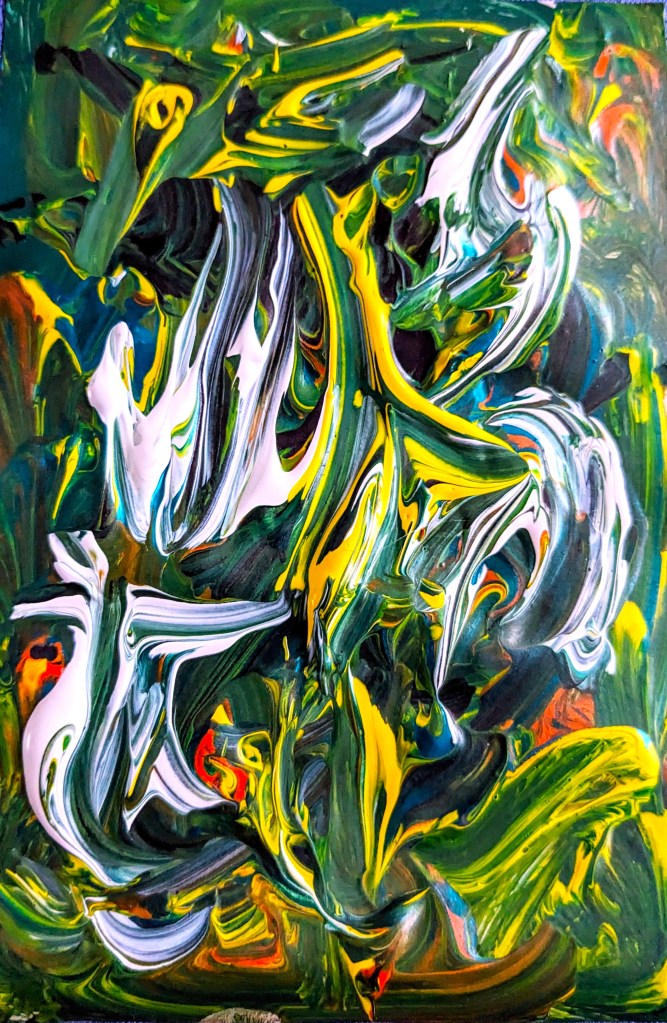
A painting and a poem dedicated to an only child who, in spite of all his achievements, was never good enough to earn the love of his parents.

Emptiness

The emptiness of air
          leaves the birch standing there,
framed by a space
          that will fill with chatter
and a flock of birds.

When evening comes,
          darkness frames the ash.
It sparkles
          with the gold dust of stars,
that swim through space.

Beneath snow’s empty page,
          grass and flowers root.
They will grow green tongues
          and rage next spring
at the coverlet
          keeping them in place.

A touch of warmth.
          Tiny flowers start to show.

What language do they speak
          as they spread their petals
and let fresh spring words flow?

My head fills with emptiness.
          My mouth is a silent space.

I sit and wait for words
          to break like sea waves
and create, who knows what,
          when they fill that empty place
within my heart and head.

What does freedom mean to you?

Daily writing prompt
What does freedom mean to you?

What does freedom mean to you?

When I look at that one word, alone on the page, I think, above all, of the multiple meanings attached to such a word, then I think of how it can be twisted in so many ways to make it mean whatever the speaker wants it to mean. So, let me begin by asking, what does freedom mean, in general, not in my own specific case.

Freedom – “the power or right to act, speak, or think as one wants without hindrance or restraint.” Interesting – no mention here of right or wrong, of truth or lies, of harassment or of perjury. Freedom – speech with no hindrance or restraint.

Freedom – the “absence of subjection to foreign domination or despotic government.” Wow! The first is very interesting but the second is extremely problematic. We need a definition of despotic and of government. We also need further clarification as to who decides what governmental despotism means. If beauty is in the eye of the beholder and if there is no arguing about taste, is the definition of despotism purely subjective? Who shall guard the guards? Does a despot consider himself or herself to be despotic? Do his or her followers? Or is it only the people who suffer and become victims of the despot’s hands, feet, orders, laws, commands, bullies, or general conduct?

Freedom – “the state of not being imprisoned or enslaved.” This is certainly much clearer. Thank you.

But consider where this very brief analysis has led us. And we haven’t even started on the Biblical meanings of freedom – “freedom from sin” – “and the truth shall set you free” – and here we are only scratching the surface of the possible religious and philosophical meanings of what the Spaniards call libre albedri’o, or free will.

What does freedom mean to you?

And now we move into the personal and the personal circumstances will change for each one of us. In my own case, freedom is my new Nexus 3 Rollator. It allows me to put aside my canes and walk around the block, something I have been unable to do for several years now. Wow – freedom to walk on my own, just leaning on my wheeled walker. Freedom to talk to my old friends, many of whom I have not seen or spoken to for a long time. Freedom to meet and talk to new neighbors, many with their lovely children and wonderful dogs. Freedom to breathe in the fresh air of early spring and to visit the flowers as they start to grow. Freedom, for me, is also the ability to see with my own eyes. Last month, I had my lenses laser-polished and now I can see again with 20/20 vision. Wow – that is really freedom, to to be able to read all but the tiniest print, without needing to use glasses. Freedom, for me, is also the ability to be able to cook, shop, move, live, without excessive pain. My new powers of walking have helped me with that. Long may it continue. It is also the good fortune to have enough money and strength to live in my own house and not to need a care home or regular home help.

Freedom – Such a magic word – such a powerful word – such a personal word. The freedom to choose to be myself, dependent on nobody else – and long may that freedom continue.